Activations
Street Play (Nukkad Natak) Agency in India
Nukkad natak campaigns for awareness, CSR and rural messaging.
Overview
What street play (Nukkad Natak) is, and when it works
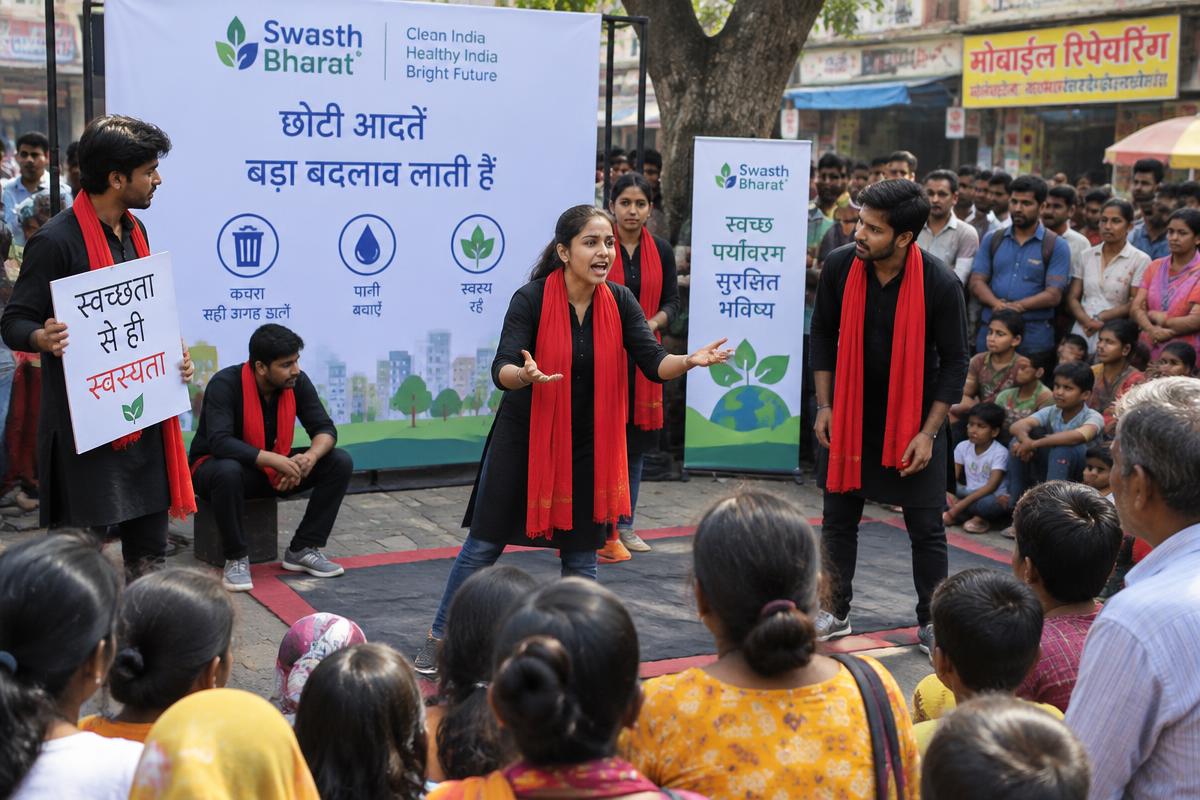
A street play, or nukkad natak, is a short, live theatrical performance carrying an awareness or product message, staged in the open at a market, haat, society or campus rather than on a conventional stage. It holds a crowd's attention considerably longer than a direct pitch because people stay to watch a story resolve, which is why it is the standard format for awareness, CSR and rural messaging where a demonstration or sampling pitch would struggle to hold an audience at all.
A performance narrative gives bystanders a reason to keep watching that a sales pitch does not, and because the message is delivered inside a story rather than stated directly, it is retained and repeated by word of mouth after the performance ends. Running the script in the local dialect rather than a translated version is what makes that retention work in practice, since a translated script reads as an outsider's message and a dialect script reads as something the audience's own community is saying.
Who it reaches
Market shoppers, residents and rural audiences who stop to watch a live performance, reached through story rather than a direct pitch.
Best suited for
- Awareness, CSR and public-health messaging needing retention, not just reach
- Rural and semi-urban audiences where a story holds attention better than a pitch
- Government-scheme communication needing a trusted, non-commercial feel
- Brands wanting word-of-mouth repetition of a message after the performance
- Locations where a demonstration or sampling pitch alone would not hold a crowd
What's included
- Script writing
- Trained actors
- Local language
- Geo-tagged proof
Investment
What street play (Nukkad Natak) costs in India
Indicative investment
₹15,000 – ₹1.5L per show
Indicative pricing for street play (Nukkad Natak) is ₹15,000 – ₹1.5L per show, exclusive of GST at 18%. It is a planning band, not a quotation — the variables that actually move it are venue-days, team size, how custom the build is, and venue or permission fees.
| Cost head | What it covers | Share of budget |
|---|---|---|
| Manpower | Promoters, supervisors, anchors, training and attendance tracking | 25%–40% |
| Fabrication & materials | Kiosk or stall build, branding, POSM, consumables | 20%–35% |
| Venue & permissions | Space rental, society or mall fees, municipal and police NOCs | 15%–30% |
| Logistics | Transport, storage, setup and dismantling | 8%–15% |
| Reporting & tech | Live dashboard, data capture, geo-tagged photo proof | 3%–8% |
Formats
Street Play (Nukkad Natak) formats we run
Market and haat performances
A short play staged in an open market or weekly haat, timed to the hours when footfall is naturally highest.
Society and campus performances
The same format adapted for a gated-society common area or a college campus, where the crowd is more captive than an open market.
CSR and government-scheme messaging
Scripts built around a public-health, safety or scheme-awareness message, commissioned by a brand, NGO or government programme.
Multi-location circuit
The same cast and script performed across several locations on a touring schedule, so one production serves many towns or villages.
Worked example
A costed example you can check
Computed from our published tier 1 day rates, not estimated.
What 8 days of street play (Nukkad Natak) actually costs
Take a 8-day street play (Nukkad Natak) programme in a tier 1 metro, staffed with 8 people (2 senior promoters, 4 promoters, 1 supervisor and 1 technician), running at a weekly haat or mela day. Here is the direct cost, computed at tier 1 rates rather than estimated.
| Cost head | Basis | Amount |
|---|---|---|
| Team | 2 senior promoters, 4 promoters, 1 supervisor and 1 technician across 8 activation days, at tier 1 day rates | ₹1,01,600 |
| Venue & permissions | 8 venue-days at the mid-point of the haat or mela band | ₹48,000 |
| Subtotal | Direct costs, excluding GST | ₹1,49,600 |
| GST | At the applicable rate on services | ₹26,928 |
| Total | Indicative, including GST | ₹1,76,528 |
Contacts engaged
12,400
At the mid-point of the planning band
Cost per contact
₹12
Direct cost ÷ contacts
Cost per lead
₹55 – ₹151
At 992–2,728 leads captured
Direct costs only. Fabrication, logistics and reporting are additional and typically add 31% to 58% of the programme budget. GST is shown at 18%. These are indicative planning figures, not a quotation.
Process
How we run street play (Nukkad Natak)
- 01Days 1-6
Script & local-language adaptation
Write the script around the message and adapt it to the local dialect rather than translating a standard version.
- 02Days 5-12
Casting & rehearsal
Cast and rehearse performers to a fixed running time, closing with a run-through validated by team members from the catchment.
- 03Days 8-16
Location permissions
Secure market committee, panchayat, society or campus permission for each location on the touring schedule.
- 04From go-live
Performance circuit
Run the touring schedule with geo-tagged, performance-wise reporting rather than a single aggregate count.
- 05After the circuit
Message-recall review
Check recall and, where relevant, enquiry capture against the plan, and adjust the script or route for any leg that underperformed.
Timing that changes the result
Demand and response peak around October to February — post-harvest liquidity makes rural routes most productive. Book teams, venues and fabrication early for that window, because vendor pricing moves with it.
Measurement
What gets reported, and how
Every campaign reports the same way: attendance against roster, geo-tagged and time-stamped photographs per venue, contacts engaged counted on the capture tool rather than estimated, and leads verified by callback before they are counted. Weak locations show up in the first week, which is the only point at which they can still be fixed.
| Metric | How it is captured |
|---|---|
| Locations and performances completed against the touring schedule | Recorded daily on the live dashboard, against the agreed target |
| Audience size gathered and retained through the full performance | Counted on the data-capture tool by promoter and venue, not estimated |
| Message recall among bystanders after the performance | Recorded daily on the live dashboard, against the agreed target |
| Enquiries or leads captured where a data-capture step follows the performance | Captured digitally with consent, then verified by callback before being counted |
| Geo-tagged, performance-wise proof filed per location | Geo-tagged, time-stamped photographs filed per venue |
Compliance
Permissions and compliance
Approvals sit on the critical path, not alongside it.
- Market committee, panchayat, society or campus permission per performance location
- Amplified-sound permission where the performance uses a public-address system
- Content clearance where the message is government, CSR or health-related
- Performer safety and crowd-stewarding plan for an open, unticketed audience
What goes wrong
Common street play (Nukkad Natak) mistakes
Each of these is something we have had to fix on a campaign someone else planned.
- Translating a standard script instead of writing it in the local dialect
- Scheduling a performance at an hour the target audience is not actually present
- Reporting a touring circuit as one aggregate number, which hides locations that were skipped
- A message buried inside entertainment so thoroughly that nobody recalls what it was for
- No crowd-stewarding plan for an open audience with no ticketing or seating
Translating a standard script instead of writing it in the local dialect
Coverage
Street Play (Nukkad Natak) by city
Each city is staffed by a local team rather than a travelling one.
Tier 1 metros
Tier 2 cities
- Street Play (Nukkad Natak) in Jaipur
- Street Play (Nukkad Natak) in Lucknow
- Street Play (Nukkad Natak) in Chandigarh
- Street Play (Nukkad Natak) in Indore
- Street Play (Nukkad Natak) in Bhopal
- Street Play (Nukkad Natak) in Surat
- Street Play (Nukkad Natak) in Vadodara
- Street Play (Nukkad Natak) in Rajkot
- Street Play (Nukkad Natak) in Nagpur
- Street Play (Nukkad Natak) in Nashik
- Street Play (Nukkad Natak) in Aurangabad
- Street Play (Nukkad Natak) in Thane
- Street Play (Nukkad Natak) in Navi Mumbai
- Street Play (Nukkad Natak) in Kochi
- Street Play (Nukkad Natak) in Thiruvananthapuram
- Street Play (Nukkad Natak) in Kozhikode
- Street Play (Nukkad Natak) in Coimbatore
- Street Play (Nukkad Natak) in Madurai
- Street Play (Nukkad Natak) in Tiruchirappalli
- Street Play (Nukkad Natak) in Salem
- Street Play (Nukkad Natak) in Mysore
- Street Play (Nukkad Natak) in Mangalore
- Street Play (Nukkad Natak) in Hubli-Dharwad
- Street Play (Nukkad Natak) in Belgaum
- Street Play (Nukkad Natak) in Visakhapatnam
- Street Play (Nukkad Natak) in Vijayawada
- Street Play (Nukkad Natak) in Guntur
- Street Play (Nukkad Natak) in Tirupati
- Street Play (Nukkad Natak) in Warangal
- Street Play (Nukkad Natak) in Bhubaneswar
- Street Play (Nukkad Natak) in Cuttack
- Street Play (Nukkad Natak) in Patna
- Street Play (Nukkad Natak) in Ranchi
- Street Play (Nukkad Natak) in Jamshedpur
- Street Play (Nukkad Natak) in Guwahati
- Street Play (Nukkad Natak) in Raipur
- Street Play (Nukkad Natak) in Bilaspur
- Street Play (Nukkad Natak) in Kanpur
- Street Play (Nukkad Natak) in Varanasi
- Street Play (Nukkad Natak) in Agra
- Street Play (Nukkad Natak) in Prayagraj
- Street Play (Nukkad Natak) in Meerut
- Street Play (Nukkad Natak) in Ghaziabad
- Street Play (Nukkad Natak) in Faridabad
- Street Play (Nukkad Natak) in Ludhiana
- Street Play (Nukkad Natak) in Amritsar
- Street Play (Nukkad Natak) in Jalandhar
- Street Play (Nukkad Natak) in Dehradun
- Street Play (Nukkad Natak) in Jammu
- Street Play (Nukkad Natak) in Srinagar
- Street Play (Nukkad Natak) in Jodhpur
- Street Play (Nukkad Natak) in Udaipur
- Street Play (Nukkad Natak) in Kota
- Street Play (Nukkad Natak) in Gwalior
- Street Play (Nukkad Natak) in Jabalpur
- Street Play (Nukkad Natak) in Goa
- Street Play (Nukkad Natak) in Siliguri
- Street Play (Nukkad Natak) in Durgapur
- Street Play (Nukkad Natak) in Puducherry
- Street Play (Nukkad Natak) in Shimla
Industries
Categories that use street play (Nukkad Natak)
FAQ
Street Play (Nukkad Natak) FAQs
What is street play (Nukkad Natak)?+
Nukkad natak campaigns for awareness, CSR and rural messaging. A street play, or nukkad natak, is a short, live theatrical performance carrying an awareness or product message, staged in the open at a market, haat, society or campus rather than on a conventional stage. It holds a crowd's attention considerably longer than a direct pitch because people stay to watch a story resolve, which is why it is the standard format for awareness, CSR and rural messaging where a demonstration or sampling pitch would struggle to hold an audience at all.
How much does street play (Nukkad Natak) cost in India?+
Indicative pricing is ₹15,000 – ₹1.5L per show. The variables that actually move a quote are the number of cities and days, team size, how custom the build is, and venue or permission fees. Tier 1 metro day rates run above tier 2. GST applies at 18%.
Which cities do you cover for street play (Nukkad Natak)?+
70 Indian cities, covering every tier 1 metro and the major tier 2 markets, each with a local team rather than a travelling one.
What is included?+
Typical deliverables are script writing, trained actors, local language and geo-tagged proof. Measurement covers locations and performances completed against the touring schedule, audience size gathered and retained through the full performance and message recall among bystanders after the performance.
Why is a street play used instead of a direct pitch for awareness messaging?+
A story holds an audience far longer than a pitch does, and a message delivered inside a narrative is remembered and repeated after the performance ends, which is exactly what a CSR or public-health campaign needs. A direct pitch on the same topic would lose the crowd within a minute.
Does the script need to be in the local language?+
Yes, in the actual dialect rather than a translation of a standard script. A translated script reads as an outside message; a dialect script reads as something the audience's own community is saying, which is central to why the format earns word-of-mouth repetition.
How many locations can one touring production cover?+
It depends on travel time between locations and performance length, which is why the touring schedule is built around realistic travel windows rather than a fixed number of stops, and why coverage is reported location by location rather than as a single circuit total.
When does a street-play campaign work best?+
Typically in the post-monsoon rural window, roughly October to February, when post-harvest liquidity and village gathering patterns both favour an open-air performance over other formats.
Related services

Activations
BTL Marketing
End-to-end below-the-line campaigns that put your brand in front of real consumers.
Activations
Brand Activation
High-impact brand activations that turn footfall into trial, leads and loyalty.
Activations
RWA & Society Activation
Reach families at home through gated society and RWA activations.
Activations
On-Ground Activation
Street-level on-ground activations in high-footfall markets and hubs.
Street Play (Nukkad Natak) guides, pricing and playbooks
- Street Play (Nukkad Natak) Cost in India: Price Guide & Budget Breakdown
- How to Plan a Street Play (Nukkad Natak) Campaign: Step-by-Step Guide
- Street Play (Nukkad Natak) Ideas That Drive Sales: Proven Formats
- Street Play (Nukkad Natak) vs Digital Ads: Which Delivers Better ROI?
- How to Choose a Street Play (Nukkad Natak) Agency in India: Vendor Checklist
- Street Play (Nukkad Natak) for Healthcare & Pharma: The Complete Playbook
- Measuring Street Play (Nukkad Natak) ROI: Formula, Attribution & Worked Example
Related searches
What people look for when they are researching this format.