Run · 12 min read · Updated 2026-10-04
Corporate Event Management Checklist: A Week-by-Week Plan
A week-by-week corporate event management checklist: objectives, venue, production, rehearsals, execution and the post-event report.
The short answer
A corporate event is managed safely by working backwards from the event date through five fixed windows: objectives and venue locked 8–12 weeks out, production and content locked 4–8 weeks out, rehearsals and logistics confirmed in the final 1–4 weeks, then execution and reporting on the day and immediately after. Each window has a short list of irreversible decisions that must close before the next window opens — treating any of them as flexible is usually what causes a visible problem on the day.
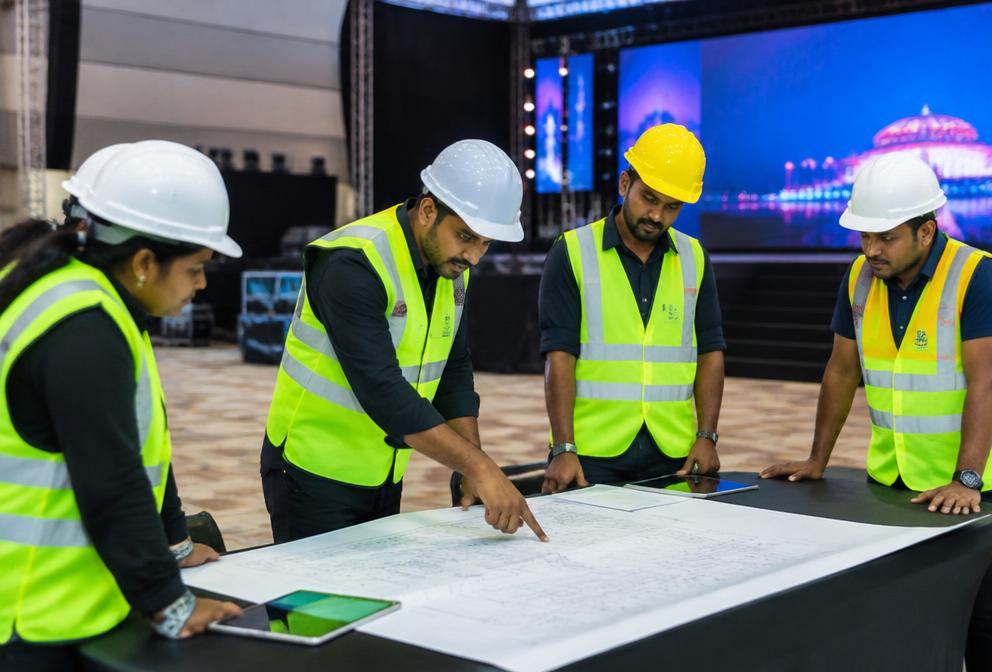
Key takeaways
- Work backwards from the event date — permissions and venue drive every other deadline
- Lock the objective and the one KPI that matters before choosing a venue, not after
- Rehearsal time is scheduled first, and the build works back from it, never the other way round
- A production budget should be itemised by cost head before it is itemised by vendor
- The post-event report matters as much as the event itself for proving the budget next time
Why a week-by-week structure matters more than a single checklist
A single flat checklist is the wrong shape for a corporate event, because the items on it do not all become urgent at the same time — booking a venue and confirming a speaker's dietary preference are both "things to do," but treating them with equal urgency either wastes weeks waiting on a trivial confirmation or leaves a genuinely critical decision until it is too late to recover from. The useful structure is a timeline worked backwards from the event date, with a short list of decisions that must close in each window before the next window can open.
The five windows that follow are not arbitrary — each one ends with a decision that is expensive or impossible to reverse once the next window has started. A venue booked in week one can still be changed in week three, awkwardly; a stage design locked in week six cannot realistically change two weeks before the event, because the fabrication and rigging plans are already built around it. Sequencing a checklist by how reversible each decision is, rather than by task category, is what actually prevents the late-stage scrambles that give corporate events their reputation for chaos.
The week-by-week plan
What follows is not a generic template padded out to eight items — each phase names the one decision that has to close in that window, and the reason it cannot safely wait for the next one. Treat the windows as hard boundaries rather than suggestions: a decision that slips from one window into the next usually drags at least one other decision with it, because the windows were ordered by dependency in the first place.
- 1
8–12 weeks out: lock objective, budget and venue shortlist
Decide the one KPI the event is judged on — attendance, leads booked, media reach — before shortlisting venues, so the shortlist is filtered by what the event needs to do, not just by what looks impressive.
- 2
6–10 weeks out: confirm venue and begin permissions
Sign the venue agreement and start municipal, fire-safety and any public-performance filings immediately — permissions are filed in dependency order, and the venue contract is usually the first document most authorities ask to see.
- 3
4–8 weeks out: lock production, content and speakers
Finalise stage design, AV specification, run-of-show content and speaker or artist confirmations together, because a late change to any one usually forces a change to the others.
- 4
3–6 weeks out: issue invitations and open registration
Send invitations once the programme is fixed enough that the agenda on the invite will not need correcting — a corrected agenda after invitations go out costs more trust than a slightly later invite.
- 5
1–4 weeks out: rehearse against a written run-of-show
Schedule a technical rehearsal and one full run on the actual stage, working backwards from rehearsal time rather than letting the build eat into it.
- 6
3–7 days out: confirm travel, hospitality and the final headcount
Lock travel and hospitality bookings against the RSVP count, with a small buffer for late confirmations, and brief every vendor on the final run-of-show.
- 7
Event day: execute against the run-of-show, not around it
A technical director and a single point of contact per workstream run the day against the written cue sheet, with changes logged rather than made silently.
- 8
48–72 hours after: close the loop
Send the feedback survey, consolidate attendance and lead data, and draft the closing report while the detail is still fresh enough to be accurate.
Who owns what, by window
A simple ownership table prevents the most common failure mode on a corporate event: a decision everyone assumed someone else had closed.
| Window | Decision that must close | Who signs off |
|---|---|---|
| 8–12 weeks out | Objective, budget, venue | Event owner and finance |
| 6–10 weeks out | Venue contract, permission filing | Venue and permissions lead |
| 4–8 weeks out | Production spec, speakers, content | Production lead and content owner |
| 1–4 weeks out | Rehearsal schedule, logistics | Production lead and logistics lead |
| Event day | Run-of-show execution | Technical director |
| Post-event | Report and budget reconciliation | Event owner |
A two-day production build, worked out
An ownership table like this one is most useful not when everything is going to plan, but at the moment something starts to slip — it tells you immediately who should already know about the slip and who needs to be told. Without it, a slipping deadline tends to be discovered by whoever notices it first, rather than by the person actually accountable for it, which is usually the more senior and more expensive way to find out.
Production — stage, crew and the build itself — is usually the largest line after venue, and it is worth seeing the arithmetic rather than accepting a number.
A two-day production build, worked out
A 2-day technical build and show in a tier 1 corporate park, crewed by 4 technicians, 2 supervisors and 3 housekeeping staff.
- Crew (4 technicians + 2 supervisors + 3 housekeeping, 2 days, tier 1 rates)
- ₹34,200
- Venue (2 venue-days at the mid-point of the corporate-park band)
- ₹60,000
Direct cost ₹94,200, or ₹1,11,156 including 18% GST — before staging, LED, lighting and sound equipment, which are quoted separately against the specific rig and typically make up the largest single line in a production budget.
This covers crew and venue only. Equipment — truss, LED, lighting, sound and power — is specified against the room and the content, not against a generic day rate, which is why it is quoted per event rather than carried in a figures table.
Budgeting a corporate event without surprises
A corporate event budget is easiest to control when it is built in the same five-head structure used across every BTL format — manpower, fabrication and production, venue and permissions, logistics, and reporting — rather than as a single number per vendor. Vendor-by-vendor budgeting hides the real driver of a cost overrun, because a single "stage vendor" invoice usually bundles crew, equipment and sometimes venue coordination into one line, making it impossible to tell afterward whether the overrun was a crew problem, an equipment problem or a scope problem that was never actually agreed.
The other recurring budget surprise is the gap between the RSVP count and the final confirmed headcount, which almost always shrinks between invitation and event day for a voluntary corporate audience. Catering, seating and gifting ordered against the RSVP number rather than a realistic confirmed-attendance estimate — typically lower — is one of the most common sources of visible, needless waste on an otherwise well-run event, and it is entirely avoidable by pricing the buffer deliberately rather than by accident.
The checklist items most teams forget
These five are forgotten for the same reason each time: none of them has an obvious deadline of its own, so each one quietly rides on the back of a bigger, more visible task until it is too late to fix cheaply.
- A written run-of-show that every vendor has seen, not just the production team
- A named single point of contact per workstream, so a question on the day has one obvious person to go to
- A rehearsal slot booked on the actual stage, not a stand-in room
- Power and sound redundancy on the show-critical path, confirmed before doors open
- A post-event report drafted within 72 hours, while the numbers are still fresh
Rehearsal time is scheduled first
Of everything on this checklist, protecting rehearsal time is the item with the clearest, most repeatable cause and effect: give it a fixed slot that cannot be encroached on, and the single most common category of event-day fault disappears almost entirely.
The build works backwards from rehearsal, not the other way round
The most common cause of a visible fault on event day is a build that ran long and ate the rehearsal slot instead of the other way round. Scheduling rehearsal first, and working the build backwards from it, is the single change that prevents more event-day problems than any equipment upgrade.
Compliance that belongs on this checklist, not as an afterthought
Compliance items are easy to schedule late because none of them is visible to a guest who had a good time — until the one time an inspector, a fire marshal or an insurer asks for the paperwork that was supposed to exist, and does not.
- Fire-safety clearance for the build and the expected crowd size
- Structural load certification for any stage, truss or rigging
- Electrical load approval and earthing checks before power-up
- Public-performance licensing where recorded or live music is played
- Venue insurance and indemnity in the format the venue requires
A run-of-show that only the production team has seen is not a plan — it is a guess that three other vendors are about to find out about.
Running the post-event report as a discipline, not a formality
A closing report that exists only to justify the budget already spent misses what the report is actually for: it is the only document that makes the next event's planning faster and its budget more accurate. A report that records not just what happened but why a specific decision was made — why this venue, why this headcount buffer, why this rehearsal schedule — gives the next event's planner a starting point instead of a blank page.
The most valuable single line in most closing reports is the gap between what was planned and what actually happened, stated plainly rather than smoothed over. An event that ran two rehearsal hours short of plan and still went well is useful information; so is one that ran exactly to plan and still had a visible fault. Both are more useful to the next event than a report that only lists what went right, because the next event's planner needs to know what to watch for, not just what to repeat.
Planning something like this?
Tell us the cities and dates and you get an itemised plan — not a lump sum.
Frequently asked questions
How far ahead should a corporate event be planned?+
8 to 12 weeks for a standard event is the realistic minimum, covering objective, budget and venue in that first window. Anything with custom fabrication, international speakers or a large guest list needs the longer end of that range, or more.
What is the biggest planning mistake on corporate events?+
Letting the build schedule determine the rehearsal time instead of the reverse. Rehearsal should be fixed first and the build worked backwards from it — a build that runs late almost always eats rehearsal time, not stage time.
Who should own the run-of-show on the day?+
A single technical director, with one named point of contact per workstream — content, hospitality, logistics — so a question on the day has an obvious person to answer it rather than being escalated upward during the show.
What should a post-event report include?+
Attendance against the RSVP count, feedback scores, media or social reach where relevant, a reconciled budget against the plan, and a short list of what to change next time — drafted within 48 to 72 hours, while the detail is still accurate.
How much does event production typically cost?+
Crew and venue for a two-day build in a tier 1 corporate park run to roughly ₹94,200 direct (₹1,11,156 with GST) for a mid-sized crew, before equipment. Staging, LED, lighting and sound are quoted separately against the specific rig and are usually the largest line in the budget.
Services this applies to
More on run
Other guides
- What Is BTL Marketing? Meaning, Formats and How It Works in India
- RWA Activation Guide: How to Market to Residential Societies in India
- On-Ground Activation Ideas, Matched to the Right Venue
- Mall Activation Cost in India: A Complete, Worked Price Breakdown
- How to Choose a BTL Agency in India: What to Compare, What to Ask
- Product Sampling Strategy: Turning Trial Into Verified Sales
- Questions to Ask a BTL Agency Before You Hire One
- How to Switch Your BTL Agency Without Losing a Campaign