Plan · 11 min read · Updated 2026-10-04
On-Ground Activation Ideas, Matched to the Right Venue
On-ground activation ideas matched to the right venue — markets, malls, societies and corporate parks — with a worked cost example and a pilot process.
The short answer
The best on-ground activation idea is not the most creative one — it is the one matched to how much time the audience has at that specific venue. A market shopper has under a minute, which rewards a fast demo or a QR instant offer; a mall atrium family has several minutes, which can carry a game or a photo experience; a tech-park lunch crowd has barely more time than the market shopper, despite the venue looking more premium. Picking the idea by venue dwell time first, then piloting two candidates against each other, outperforms picking the most imaginative idea in a brainstorm.
Key takeaways
- Match the idea's required attention span to the venue's actual dwell time, not to how good it looks in a deck
- Build the lead-capture step into the mechanic itself, never bolt it on afterward
- Every idea needs a hook, an instant reward and a data-capture moment
- Pilot two ideas for the same objective and the same number of venue-days before scaling either
- Rank by cost per lead after the pilot, not by which idea felt more fun on the day
Picking the right idea starts with the venue, not the gimmick
The idea that performs best on paper is rarely the idea that performs best on the ground, because performance is decided by three things a brainstorm cannot see: how much time people actually have at that venue, whether the hook matches what they came there to do, and whether the team can capture a contact without breaking the interaction. A spin-the-wheel game that works brilliantly at a weekend mall atrium, where families are unhurried, usually fails at a corporate-park lunch window, where the same person has eleven minutes and somewhere to be. The venue sets the ceiling on what any idea can achieve; the idea only decides how close to that ceiling you get.
That is why the ideas below are grouped by where they are run rather than listed as one undifferentiated set. Pick the venue your audience is actually in, then pick the idea that fits the time they have there.
It is worth separating two different kinds of "idea" that get lumped together in a casual brainstorm: a hook, which is the few seconds that gets someone to stop or look, and a mechanic, which is what happens once they have stopped — a game, a demo, a form. A weak hook with a strong mechanic never gets tested, because nobody stops long enough to find the mechanic. A strong hook with a weak mechanic gets plenty of attention and converts almost none of it. Most ideas that under-perform fail at one of these two stages specifically, which is a more useful diagnosis than "the idea didn't work."
That distinction also has a budget implication worth stating plainly: a better hook is almost always cheaper to fix than a better mechanic. Sharpening the first five seconds of a pitch, or redesigning a standee's headline, costs a conversation and a reprint; redesigning the actual engagement — the game, the demo, the form — usually means new props, new training and a new pilot. When a location under-performs, it is worth testing whether a cheap hook fix solves it before committing to an expensive mechanic rebuild.
Ideas for busy markets and canopies
Shoppers here are moving, so the hook has to land fast:
- A live demonstration counter where the product does something visible in under a minute — the only format that reliably stops a moving shopper
- A sampling table paired with a one-question survey, so every sample handed out also returns a data point
- A spin-the-wheel or scratch-card tied to an instant, small reward, which works because the reward is immediate rather than promised
- A local-language anchor doing a short, loud call-to-action every few minutes, which recruits the crowd a quiet table cannot
- A QR-code instant-offer standee that lets a shopper self-serve a discount without queuing for a promoter's time
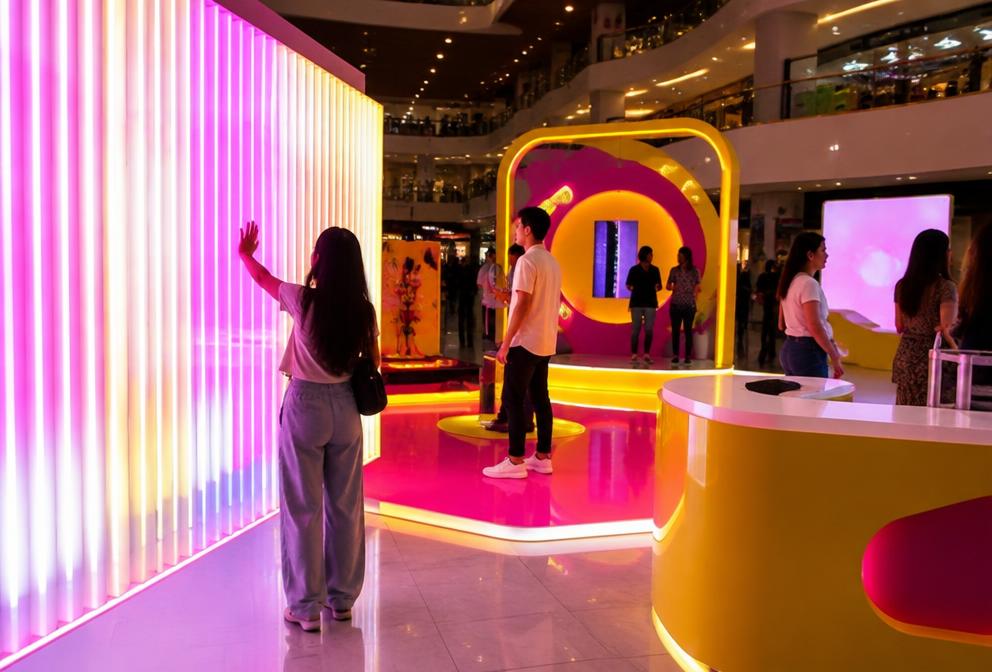
Ideas for malls and atriums
A market crowd is also the least forgiving audience for a confusing stall layout, because nobody is going to walk around a setup to figure out what it is for — the product, the offer and the action need to be visible from several steps away, in the time it takes to decide whether to change direction at all. Dwell time in a mall atrium is longer, and families will engage with more production:
- A gamified booth with a leaderboard, which works in an atrium because families linger and a public score creates its own audience
- A branded photo booth or AR filter experience, where the output is something people want to carry out of the mall, extending reach past the day itself
- A kids' zone adjacent to the main pitch, which is less about children and entirely about holding parents at the stall long enough for the real conversation
- A before-and-after product demo staged like a small show, timed to the atrium's natural footfall peaks rather than run continuously
- A guided trial station with a supervisor logging results on a tablet, suited to categories — skincare, eyewear, hearing — where the trial itself is the pitch
Ideas for societies and campuses
Societies and campuses share a trait that changes which ideas work: the audience is not transient. A family seen today at a society gate will likely be seen again next month by the same brand or a different one, and a student seen today on campus will be on the same campus next semester. Ideas here can afford to build toward a longer relationship — a referral, a repeat visit, a loyalty mechanic — in a way a one-time market encounter cannot.
- A doorstep-adjacent kiosk at the society gate, reaching residents on their way in rather than asking them to detour
- A kids' activity corner at the clubhouse, which — exactly as in a mall — is there to hold parents, not children
- A campus contest or challenge with a leaderboard and a modest prize, tuned to a student audience that responds to competition more than discounts
- A referral mechanic that rewards a resident or student for bringing a friend to the stall, which works because the introduction carries more trust than the promoter's own pitch
Ideas for corporate parks and workplaces
A workplace audience is the most time-poor of any venue on this list, and also, somewhat counter-intuitively, one of the easiest to convert once engaged — because the setting itself carries implicit trust (an employer allowed this onto the premises) and because the five minutes someone gives up at lunch is a real, deliberate choice rather than an idle pause. Ideas built for this audience should assume the decision to engage has already been made and focus entirely on using the available minutes well.
- A fast desk-side or lobby demo timed to the lunch window, built for an audience with minutes rather than an afternoon
- A free assessment or check — eye, posture, financial, skin — that trades a useful five minutes for a captured contact
- A referral or employee-benefit tie-up run through HR, which converts because the introduction comes with implicit employer trust
Matching idea to objective
Choosing between the ideas above is easier once the objective is named first, because trial, leads and awareness reward different mechanics and are measured completely differently. A brand that wants trial but measures the campaign on contacts engaged will keep running an idea that is actually underperforming on the number that matters.
| Objective | Best-fit format | What to measure |
|---|---|---|
| Trial | Live demo or sampling counter | Trials given against stock issued |
| Leads | QR instant-offer or guided trial with data capture | Leads captured and verified |
| Awareness and recall | Gamified booth, photo or AR experience | Contacts engaged and content shared |
| Footfall at a nearby store | Society or campus kiosk with a redeemable coupon | Coupon redemption at the linked outlet |
Making an idea repeatable across cities
An idea that works brilliantly once, in one city, with one exceptional team, is not the same as an idea that works reliably across ten cities with ten different teams. The gap between the two is almost always the script — the specific words, timing and sequence a promoter follows — rather than the concept. An idea with a tight, written script and a short, scored training session travels; an idea that depends on one gifted promoter's improvisation does not, and brands that try to scale the second kind are usually scaling a training problem, not an idea.
What a five-day tech-park push costs, worked out
Here is the arithmetic for a corporate-park idea run across a working week.
A five-day tech-park push, worked out
A 5-day lunchtime engagement idea in a tier 1 corporate park, staffed by 3 promoters and 1 supervisor.
- Team (3 promoters + 1 supervisor, 5 days, tier 1 rates)
- ₹29,000
- Venue (5 venue-days at the mid-point of the corporate-park band)
- ₹1,50,000
Direct cost ₹1,79,000, or ₹2,11,220 including GST, against an estimated 2,250 contacts across the five days — about ₹80 per contact, and 180 to 495 leads, a cost per lead of roughly ₹362 to ₹994.
Corporate-park venue fees run high relative to footfall because access is limited and negotiated with park management rather than booked off a public rate card — which is exactly why a lunch-window idea needs a strong hook to justify the venue cost.
Match the hook to the dwell time
Dwell time is not something a brand controls directly, but it is something that can be read off the venue before a single rupee is spent on production. Watching how long people naturally linger at a venue — at the videos they stop for, the queues they tolerate, the benches they sit on — is a better guide to how much idea a location can support than any assumption based on the venue's category or prestige.
A working rule of thumb
An idea that needs under a minute of attention works anywhere, including a moving market crowd. An idea that needs two to five minutes needs a venue where people are already pausing, such as a mall atrium or a society clubhouse. Anything needing longer than that only works where the audience has chosen to be there, such as a campus fest or a ticketed event. Running a five-minute idea in a one-minute venue is the single most common reason an on-ground idea under-delivers.
How to pilot and choose the winning idea
Running a proper pilot is the difference between choosing an idea on instinct and choosing it on evidence, and it costs very little extra to do it properly — the same venue-days and the same budget, just split between two ideas instead of committed entirely to one guess.
- 1
Shortlist two ideas, not one
Pick two candidate ideas for the same objective and venue type, so the comparison is between ideas and not between locations.
- 2
Run both for the same number of venue-days
Equal exposure is the only way the comparison is fair — more days for one idea just means more contacts, not a better idea.
- 3
Capture the same data for both
Contacts, trials, leads and cost per lead, recorded the same way for each, so the numbers can be placed side by side.
- 4
Rank after the pilot, not during it
Resist changing either idea mid-pilot; a mid-course correction makes the comparison unusable.
- 5
Scale the winner, retire the other
Move the full location list and budget to whichever idea produced the lower cost per lead, and stop running the other anywhere.
Planning something like this?
Tell us the cities and dates and you get an itemised plan — not a lump sum.
Frequently asked questions
How many on-ground activation ideas should a brand test at once?+
Two, for the same objective and venue, run for equal venue-days. Testing more than two at once makes it hard to isolate why one idea outperformed, and testing only one means there is nothing to compare it against.
What makes an idea work in a mall atrium versus a market?+
Dwell time. Shoppers in a market are moving and need a hook that lands in under a minute; families in a mall atrium have paused and will give a well-designed idea several minutes, which is why atrium ideas can carry more production — games, photo booths, guided trials — than a market canopy can.
Do games and contests actually produce leads?+
Only if a lead-capture step is built into the mechanic itself — a form before the spin, a phone number before the prize is handed over — rather than bolted on afterward. A game with no capture step produces engagement and nothing to show for it.
Should every idea include a free sample or reward?+
Not every one, but the idea needs some immediate reason to engage, and a sample or small reward is the simplest version of that. Ideas that ask for attention and offer nothing back under-perform ideas that trade something small and instant.
How is an on-ground idea measured?+
Against the objective it was built for — trials given against stock issued, leads captured and verified, or contacts engaged and content shared for an awareness idea — never on footfall alone.
Services this applies to
More on plan
- Mall Activation Cost in India: A Complete, Worked Price Breakdown
- Product Sampling Strategy: Turning Trial Into Verified Sales
- How to Write a BTL Brief That Gets Comparable Quotes
- BTL Agency Pricing: Retainer vs Project vs Rate-Card vs Outcome-Linked
- BTL Campaign Budget Planning: How to Build the Number From the Ground Up
Other guides
- What Is BTL Marketing? Meaning, Formats and How It Works in India
- RWA Activation Guide: How to Market to Residential Societies in India
- How to Choose a BTL Agency in India: What to Compare, What to Ask
- Corporate Event Management Checklist: A Week-by-Week Plan
- Rural Marketing in India: Formats, Timing and Verified Coverage
- Questions to Ask a BTL Agency Before You Hire One
- How to Switch Your BTL Agency Without Losing a Campaign
- In-House vs Agency BTL Marketing: An Honest Comparison