Understand · 10 min read · Updated 2026-10-04
RWA Activation Guide: How to Market to Residential Societies in India
How RWA and society activations work in India: approvals, formats, categories that perform best, and a fully worked cost-per-society example.
The short answer
An RWA (residents' welfare association) activation is a branded kiosk, canopy or stall run inside a gated residential society, usually on a weekend, to put a product or service directly in front of households through demonstration, sampling and lead capture. It works by trading the committee a day's fee and the brand's compliance for access to an audience that is otherwise hard to reach at scale — families at home, together, with time to engage — and the cost and output of a single society day can be computed exactly once a city tier, team size and venue fee are known.
Key takeaways
- An RWA activation needs the committee's approval before anything else — it is a commercial negotiation, not a formality
- Families respond best on weekends and early evenings, when the decision-maker is actually present
- Cost is driven by venue fee and team size, not by the society's size alone
- Running many societies and ranking them by cost per lead beats guessing which ones will work
- FMCG, broadband, real estate, solar, home services, education and healthcare see the strongest RWA response
What an RWA activation actually is
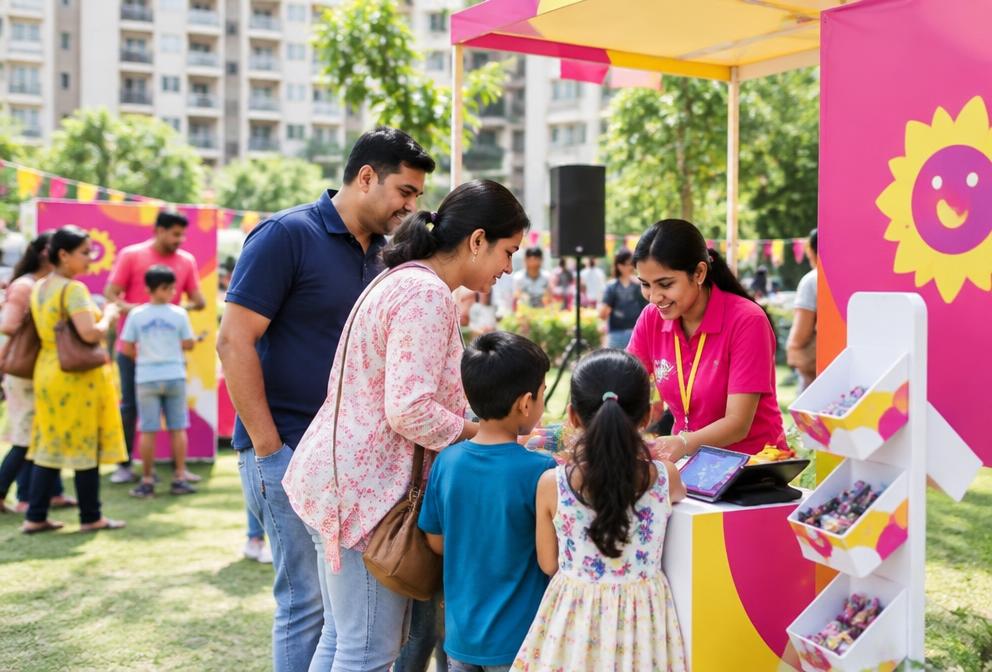
An RWA activation places a small branded setup — a kiosk, a canopy, sometimes just a table and standees — inside a gated residential society, with the managing committee's approval, usually for a weekend morning or a weekday evening when residents are home. A promoter or two run a demonstration, hand out samples, and capture contact details, all inside the society's common area rather than at a market or a mall.
What makes it a distinct format rather than just a smaller mall activation is the audience: a household, together, in a setting they trust and are not in a hurry to leave. That changes the pitch, the pace and the tone a promoter should use, which is the first thing that goes wrong when a team briefed for a market canopy is sent into a society instead.
The format sits between two things that look similar but behave differently: a market canopy, where volume of strangers is the resource, and a corporate event, where a small, invited group is the resource. A society activation is closer to neither — it is a semi-public space with a gatekeeper, the committee, standing in for an audience that has not individually opted in, which is why the first and most important negotiation is not with a single resident but with that committee, on behalf of everyone the activation will actually meet.
Running a society activation well also means accepting a slower, quieter sales pace than a market canopy — residents are not in a transactional mindset the way a shopper mid-errand is, and pushing too hard for an immediate close tends to read as exactly what it is: a stranger pressuring someone in their own home environment. The promoters who perform best in societies are usually the ones with the patience for a longer, more conversational pitch, which is also why the briefing for a society team should differ from the briefing for a market team even when the product and the script are otherwise identical.
Why societies work as a venue
A society concentrates exactly the audience most brands actually want to reach — an identifiable household, at home, with the decision-maker present rather than at work — inside a space that is already safe, enclosed and trusted by the people in it. A market gives you volume of strangers passing through; a society gives you fewer people, but each one is the actual buyer, not a passer-by who happens to fit the profile.
That trade-off is why RWA activations are usually judged on cost per lead rather than cost per contact: the number of people reached in one society day is modest next to a mall atrium, but a far larger share of them are genuinely in-market, which is what the lower funnel numbers end up reflecting.
There is also a practical reason societies work for categories that need a second conversation. A mall contact or a market contact is, in the vast majority of cases, a single encounter — the shopper leaves and the promoter has one chance to make the case. A society contact is different: the promoter, or a colleague, is likely to be back in the same society in a few weeks for a different brand or a repeat visit, and the resident knows the activation did actually happen in their own space, not somewhere they merely passed through. That makes a follow-up call or message land very differently.
A mall gives you footfall; a society gives you the household that actually decides.
How society approval actually happens
Securing a society slot is often treated as an administrative afterthought squeezed into the week before go-live, and that is exactly the assumption that causes it to slip. A committee is a group of residents making a decision on behalf of their neighbours, usually in their spare time, and they move at the pace of their own meeting calendar — not at the pace of a campaign's launch date. The realistic lead time for a first-time approach to a new society is two to four weeks, not two to four days, and that number should be built into the campaign plan from the first week, not discovered when the committee's next meeting turns out to be three weeks away.
Getting into a society is a sequence, not a single application, and skipping a step usually costs more time than doing it in order:
- 1
Shortlist target societies
Pick societies by household profile and size rather than proximity alone — a 200-flat society matched to your audience outperforms a 600-flat society that is not.
- 2
Pitch the committee
Present the format, the space needed, timing and what residents get out of it. Committees approve activations that read as a benefit to residents, not just a fee.
- 3
Negotiate the society fee
The fee is a commercial negotiation, not a statutory charge, and it varies by city, society size and season — budget for it as its own line, separate from any municipal cost.
- 4
Book the slot
Confirm the date and time window in writing, usually a weekend morning or evening slot when families are home and not rushing somewhere.
- 5
Share compliance paperwork
Give the committee staff verification, insurance and a data-handling undertaking ahead of time — most delays at this stage are paperwork the committee asked for and did not receive until the week of the activation.
- 6
Brief the on-ground team
Promoters working a society need a softer register than a market pitch — residents are at home, not shopping, and respond to a friendly, unhurried approach.
- 7
Run and report
Execute with geo-tagged photos, a daily contact count and verified leads, then leave the committee with a thank-you gesture — the relationship outlasts one activation.
What a single society day costs, worked out
Cost conversations about RWA activations often start from the wrong end — a brand asks what a "society activation" costs as if it were one product with one price, when the actual cost is built from the same two inputs as every other BTL format: the team on the ground and the fee the venue charges. The only thing specific to a society is that the second number, the venue fee, is a negotiated commercial figure rather than a published rate card, which is exactly why it is worth seeing the arithmetic for a single day before trying to plan a programme across dozens of societies.
Here is the arithmetic for the smallest realistic unit of an RWA programme: one society, one day, a lean team.
One society, one day, worked out
A 1-day society activation in a tier 1 city, staffed by 2 promoters and 1 supervisor.
- Team (2 promoters + 1 supervisor, 1 day, tier 1 rates)
- ₹4,600
- Venue (1 venue-day at the mid-point of the society fee band)
- ₹26,500
Direct cost ₹31,100, or ₹36,698 including 18% GST, against an estimated 260 contacts for the day — about ₹120 per contact, and 21 to 57 leads depending on where the day lands in the usual range, a cost per lead of roughly ₹546 to ₹1,481.
The society fee, not the team, is the larger line here — a reminder that the committee's commercial fee is the real variable to negotiate, not team size.
Scaling across a weekend
A brand that has validated the single-day arithmetic above usually wants to know what a real programme looks like, which in practice means many societies run across a weekend rather than one society run once. The honest answer is that the unit economics do not change at all — each society is still its own venue-day, with its own team and its own fee — which means the programme's total cost and total output can be read directly off the single-day numbers, multiplied by however many societies are actually booked.
The arithmetic scales linearly, the logistics do not
Run the same brief, same team size and same tier across 10 societies in one weekend and the direct cost scales to ₹3,11,000 (₹3,66,980 with GST), reaching an estimated 2,600 contacts and 210 to 570 leads. What does not scale automatically is quality — each society still needs its own booked slot and its own briefed team, which is why a 10-society weekend needs committee approvals running in parallel for weeks before it, not days.
Which categories work best, and why
Fit with the format is less about industry labels and more about a single question: is this something the household decides on together, in the home, rather than something one person decides alone at a desk or a counter? Categories that pass that test tend to outperform categories that do not, almost regardless of how generous the activation's production is, because the format's entire advantage is reaching the whole decision unit in the room where the decision actually gets made.
| Category | Why the society venue fits | Typical hook |
|---|---|---|
| FMCG | Households decide together, and a kitchen or home-care product is used by everyone in the flat | Live demo plus a take-home sample |
| Broadband & telecom | The decision-maker and the weak Wi-Fi signal are both at home, where the pitch is most credible | A speed test on the resident's own phone |
| Real estate | Buyers in one society often fit the profile for a comparable nearby project | A walk-through video and a site-visit booking |
| Solar & home services | The roof or balcony being sold against is the one right there | An on-the-spot feasibility check |
| Education | Parents are reachable together, in the evening, without a school intermediary | A trial class or assessment slot |
| Healthcare | Screening camps work best where people already feel safe and unhurried | A free basic health check |
Compliance and etiquette inside a society
Compliance inside a society reads, at first glance, like a smaller version of a mall's rulebook, but the enforcement is personal rather than institutional — a mall's security desk enforces a rule because it is a rule; a society's gate guard or committee member enforces it because a neighbour complained, and that neighbour will be at the next meeting. Getting these details right the first time is what earns a second booking; getting them wrong, even on something minor, is often what loses a society for every future brand an agency tries to bring in, not just the one that caused the complaint.
- Noise and timing restrictions set by the committee, often stricter than municipal rules
- Gate security and visitor registration for every team member, briefed in advance
- Fire and electrical safety for any powered unit inside common areas
- A written data-handling undertaking, because promoters are collecting residents' personal contact details
- Waste and space clean-up before the committee's own deadline, not the activation's
Mistakes that undercut an RWA programme
Every mistake on this list has the same signature: it looks like a minor shortcut taken to save a day or two of planning time, and it costs a multiple of that time back in a worse slot, a declined return visit, or a campaign that ran but produced far fewer leads than the contact count would suggest.
- Pitching the committee on footfall promises instead of what residents actually get
- Booking a weekday daytime slot in a society where everyone who matters is at work
- Skipping the fee negotiation and getting a worse slot the next time
- No supervisor on site, so a resident complaint has nobody to answer it
- Treating every society as equal instead of ranking by cost per lead after the first few
Planning something like this?
Tell us the cities and dates and you get an itemised plan — not a lump sum.
Frequently asked questions
How much does an RWA activation cost per society?+
For a single day with 2 promoters and 1 supervisor in a tier 1 city, direct cost runs about ₹31,100 (₹36,698 with GST), covering an estimated 260 contacts — call it ₹120 per contact. Tier 2 cities and smaller teams cost proportionately less; venue fee and team size move the number, not the brand.
Who approves an RWA activation?+
The society's managing committee, not any government authority — it is a commercial decision the committee makes on behalf of residents, usually against a fee and a booked slot, with compliance paperwork submitted ahead of time.
What time of day works best?+
Weekend mornings and weekday evenings, when the household's decision-makers are actually home together rather than at work or ferrying children between activities.
Which categories see the best response in societies?+
FMCG, broadband and telecom, real estate, solar and home services, education and healthcare consistently perform best, because each sells something the household decides on together, at home.
How do you measure an RWA campaign?+
Per society per day: contacts engaged, samples distributed against stock issued, leads captured and verified, and cost per lead — ranked across societies so the weak ones are visible within the first weekend rather than at the end of the programme.
Services this applies to
More on understand
Other guides
- On-Ground Activation Ideas, Matched to the Right Venue
- Mall Activation Cost in India: A Complete, Worked Price Breakdown
- How to Choose a BTL Agency in India: What to Compare, What to Ask
- Corporate Event Management Checklist: A Week-by-Week Plan
- Product Sampling Strategy: Turning Trial Into Verified Sales
- Rural Marketing in India: Formats, Timing and Verified Coverage
- Questions to Ask a BTL Agency Before You Hire One
- How to Switch Your BTL Agency Without Losing a Campaign