Run · 11 min read · Updated 2026-10-04
Rural Marketing in India: Formats, Timing and Verified Coverage
Rural marketing in India: formats, timing and village-level verification, with a fully worked haat-circuit cost example.
The short answer
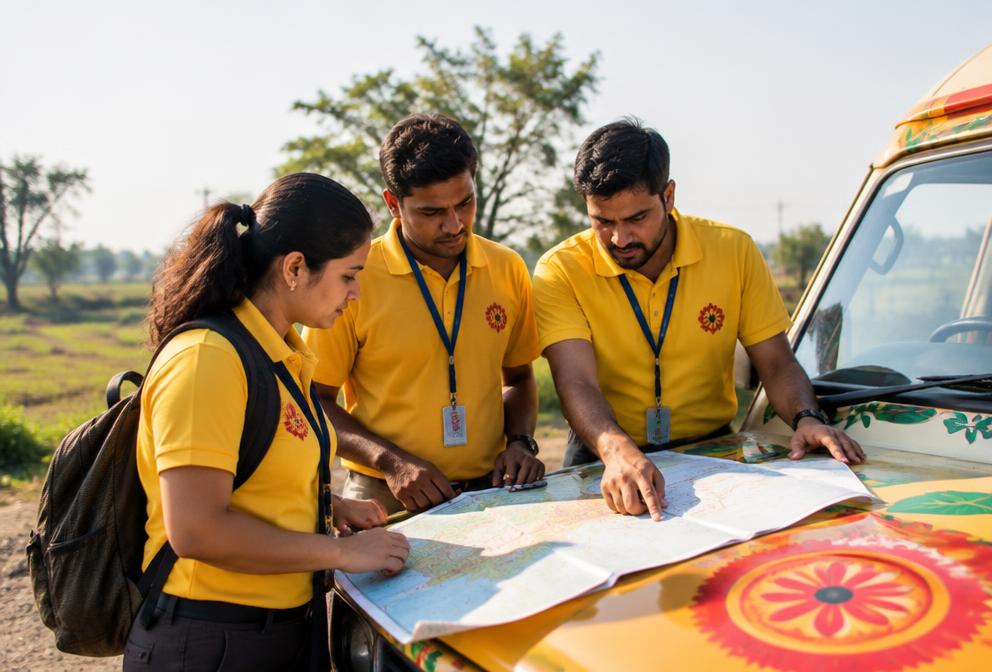
Rural marketing in India reaches consumers through the places rural life already concentrates — weekly haats and melas, village centres and audio-visual van routes — using local-language demonstration rather than mass-media recall, because rural purchase decisions lean on trust and seeing a product work far more than on advertising alone. A worked five-day haat circuit in a tier 2 district, with a four-promoter team, a supervisor and one audio-visual van, costs about ₹1,09,000 direct (₹1,28,620 with GST) and reaches an estimated 7,750 contacts — a cost per contact of around ₹14, far below any urban format, because a single haat day concentrates the footfall of many surrounding villages in one place.
Key takeaways
- Haats and melas concentrate many villages' footfall into one day, which is why rural cost per contact runs so low
- Post-monsoon liquidity (October–February) changes what a household will actually buy, not just how receptive it is
- Local-dialect content outperforms translated metro creative, because a translation reads as an outsider's pitch
- Coverage has to be reported village by village — a district-level average hides exactly the villages that were skipped
- Demand without nearby distribution converts interest into frustration, not sales
Why rural marketing is a distinct discipline, not urban activation moved outward
Rural marketing is often described as urban activation run further from a city, and that description is exactly wrong. The audience, the language, the purchase cycle, the trust mechanics and what counts as proof of coverage are all different, and a plan that simply moves a metro canopy format outward usually produces attendance without purchase. Rural purchase decisions lean far more on demonstration and local trust than on advertising recall — a product shown working, explained in the dialect a household actually speaks at home, in a setting the community already trusts, converts in a way that no amount of urban-style media weight reliably does.
The proof-of-coverage difference deserves its own mention, because it is where a rural programme most often loses a client's trust without anyone intending it to. An urban campaign's footfall is visible and roughly self-evident — a mall or a society either had people in it or it did not, and anyone can check. A rural route's coverage is not self-evident at all: a van that skipped two villages on a six-village route looks, on a simple attendance summary, identical to one that covered all six, unless the reporting is built specifically to catch that difference.
None of this makes rural marketing harder in the sense of being less effective — it is, by the venue economics worked through later in this guide, one of the most efficient formats in cost per contact available in Indian BTL marketing. It makes rural marketing harder in the sense of requiring a plan that takes language, timing and verification seriously as separate problems, rather than assuming a format proven in a metro will simply travel outward unchanged.
Government and CSR-style awareness programmes share the rural toolkit with brand campaigns but differ in one important respect: the measure of success is usually comprehension and reach rather than purchase, which changes which format leads. A street play or a village-centre demonstration built to explain a scheme or a health practice can succeed entirely on attention and understanding, with no retailer or stockist question attached at all — which is also why those formats sit comfortably alongside commercial rural marketing without being the same activity under a different name.
The formats that actually work
- Haat and mela activation — a canopy or stall at a weekly market or fair, where one day concentrates the footfall of many surrounding villages into a single, plannable location
- Audio-visual van route — a van covering several villages a day with a screen, a public-address system and a live demo, scripted in the local dialect
- Street play (nukkad natak) — a short live performance that holds a crowd far longer than a sales pitch would, suited to awareness and CSR messaging as much as to a product
- Village-centre demonstration — a demo run at the village's natural gathering point, usually alongside a local shopkeeper or influencer who already carries trust
- Retailer and stockist engagement — working the village and small-town counter directly, so the demand a campaign creates has somewhere nearby to be fulfilled
- Farmer and community meets — structured sessions for agri and allied categories, where the product needs explaining rather than sampling
Timing: why the season changes the result
These six formats are rarely run in isolation — a typical district programme combines two or three of them deliberately, because each does a different job. The haat or mela activation is where the concentrated footfall is; the AV van route is what reaches the villages that do not have a haat day falling inside the campaign window; the street play or village-centre demo is what builds the trust that converts a one-time sample into a repeat buyer; and retailer engagement is what makes sure all of that interest has somewhere to turn into a sale.
Timing changes more than response rate — it changes what a household can actually afford to buy that week. The post-monsoon window, broadly October through February, is when harvest proceeds turn into cash in hand, and a programme timed to that window reaches the same villages with materially more purchasing power than the identical programme run against a tight pre-harvest cash cycle. A rural plan should be built around the district's own harvest and market calendar, not around when a media plan happens to have a gap.
The same logic extends to within-week timing, not just within-year timing. Haat days themselves are usually fixed on a weekly cycle specific to that market, and a programme that shows up on the wrong day finds an empty ground where a thriving market was supposed to be. Route planning for a rural programme has to start from the haat calendar and the harvest calendar together, rather than from a generic "rural season" assumption applied uniformly across a state that may have several different cropping and market cycles within it.
A five-day haat circuit with an AV van, worked out
Here is a five-day haat circuit worked out in full, van included.
A five-day haat circuit with an AV van, worked out
4 promoters and 1 supervisor working 5 haat days across a tier 2 district, supported by one audio-visual van for all five days.
- Team (4 promoters + 1 supervisor, 5 days, tier 2 rates)
- ₹26,500
- Venue (5 haat-days at the mid-point of the tier 2 haat/mela band)
- ₹15,000
- Audio-visual van (5 days at the mid-point of the day-rate band)
- ₹67,500
Direct cost ₹1,09,000, or ₹1,28,620 including 18% GST, against an estimated 7,750 contacts across the five haat days — a cost per contact of about ₹14, and 620 to 1,705 leads, a cost per lead of roughly ₹64 to ₹176.
The van is the single largest line in this budget, not the team — 62% of the direct cost is the van alone. Where a route does not need broadcast reach on top of the ground team, dropping the van cuts the programme's direct cost by roughly three-fifths, to about ₹41,500 for the same five haat days.
Why cost per contact runs so much lower at a haat
It is also worth comparing this total against what the identical team and venue would cost in a tier 1 city, because the comparison is instructive about where rural budgets should actually go. A tier 1 team of this size would cost meaningfully more on manpower alone, before even reaching the venue-fee gap — which means a given rupee of rural budget buys proportionally more team and more van time than the same rupee would in a metro, making rural programmes a relatively efficient place to invest additional reach once the core urban markets are already covered.
The gap is not a rural discount — it is venue economics. A haat already concentrates several villages' footfall in one place for one day, at a fraction of a mall's space fee, so the same team reaches many more people per rupee of venue cost. What a haat does not do automatically is convert that reach into distribution-ready demand, which is why retailer engagement runs alongside the consumer activity rather than after it.
| Format | Venue | Cost per contact (worked example) |
|---|---|---|
| Society activation (tier 1, 1 day) | Residential society gate | ₹120 |
| Mall atrium (tier 1, weekend) | Metro mall atrium | ₹106 |
| Haat circuit (tier 2, with AV van) | Weekly rural market | ₹14 |
Local language is not a translated script
This comparison is not an argument for abandoning urban formats in favour of rural ones — a society or a mall reaches a different buyer with a different purchasing pattern, and the cost-per-contact gap reflects venue economics, not relative importance. It is, however, a useful corrective for a national budget conversation that sometimes treats rural coverage as an expensive afterthought to the "real" metro campaign, when the arithmetic usually runs the other way.
Language is the single variable most likely to be underestimated by a team planning a rural programme from a city office, because the gap between "speaks the state's official language" and "speaks the way this specific district actually speaks at home" is wider than it looks on a map. A script that tests perfectly well with a city-based regional-language reviewer can still land as stilted or foreign in a specific district, which is exactly why validation happens with people from the catchment itself, not with anyone who merely shares the state language.
Written for the dialect, not translated into it
A script translated from metro creative reads, to a rural audience, as an outsider's pitch — the words change but the voice does not. Content that actually works is written in the dialect from the start and checked by team members from the catchment, which is also why rural teams are recruited locally rather than travelled in: a travelled-in team can learn the language but rarely earns the same trust on day one.
Running a verifiable rural programme
The six steps below are ordered deliberately — language and local recruitment come before permissions and execution, because a programme that gets the route and the permissions right but the language wrong still fails on the ground, while the reverse is rarely true.
- 1
Map the district by haat day and harvest calendar
Build the route around where and when the audience naturally gathers, not around road convenience.
- 2
Write content in the dialect, not a translation
Produce scripts and performances locally and validate them with team members from the catchment before they go live.
- 3
Recruit and train local-language teams
Local recruitment earns trust that a travelled-in team, however well briefed, usually cannot match on day one.
- 4
Secure panchayat, market committee and route permissions
These run on a different clock from municipal approvals in a city, and need their own lead time.
- 5
Report village by village, not district by district
A district-level total hides exactly the villages that were skipped — the village is the smallest unit that should ever appear on a report.
- 6
Review fortnightly and reallocate toward what is actually converting
Move days toward the villages and haats producing real offtake, and away from ones producing only engagement.
What rural distribution has to be ready for, before the activation runs
The fortnightly review step above is where most of the programme's actual optimisation happens, and it depends entirely on the village-wise reporting that comes before it — a programme reviewed only at district level has nothing to reallocate toward, because it cannot see which specific villages or haats were worth the visit and which were not.
A rural activation's job is to create demand; it is not, on its own, able to fulfil that demand, which means the single most important question to answer before a route is finalised is not about the activation at all — it is whether the villages on that route have a nearby retailer who actually stocks the product. A village that responds well to a demonstration, with no stockist for several kilometres in any direction, converts enthusiasm into frustration rather than into a sale, and the next team that visits that village starts from a worse position than if no activation had run there at all.
The practical sequencing this implies is that retailer and stockist engagement should be confirmed before the consumer-facing route is locked, not run as a parallel or follow-up activity. Where distribution genuinely does not reach a promising village yet, the activation is better used as evidence to justify extending distribution there, rather than as a consumer push that distribution cannot support.
Mistakes that undercut rural programmes
As with every mistakes list in this guide series, none of these five requires extra budget to avoid — they require planning the route and the language from the district's own calendar and dialect, rather than from a template built for a different market.
- Translating metro creative instead of writing for the dialect from the start
- Routing by road distance and missing the haat day entirely
- Reporting coverage at district level, which hides the villages that were skipped
- Creating demand in a village with no nearby retailer stocking the product
- Running the programme against the wrong part of the household cash cycle
A haat already does the hardest part of rural marketing for free — it gathers the villages. What you still have to earn is the trust, in their language, on the day.
Planning something like this?
Tell us the cities and dates and you get an itemised plan — not a lump sum.
Frequently asked questions
When is the best time to run a rural marketing campaign?+
The post-monsoon window, roughly October to February, because post-harvest liquidity changes what a household can actually buy that week. The same activation run against a tight pre-harvest cash cycle produces engagement but far fewer purchases.
Why is rural cost per contact so much lower than urban formats?+
Venue economics, not a rural discount — a haat or mela already concentrates many villages' footfall into one place for one day, at a fraction of a mall or society's venue fee, so the same team reaches far more people per rupee spent on venue.
Do I need an audio-visual van for a rural campaign?+
Only if the objective needs broadcast reach on top of ground engagement — in the worked example above, the van is 62% of the direct cost, and a haat-day team without it still covers the same villages at roughly three-fifths less direct cost.
How is rural coverage actually verified?+
Village by village, geo-tagged and time-stamped, never as a district total. A district average is exactly where a skipped village hides, which is why the village, not the district, is the smallest unit a rural report should show.
Does rural marketing work without local distribution?+
Poorly — the format is very good at creating interest and very bad at fulfilling it on its own. Retailer and stockist engagement needs to run alongside the consumer activity, not after it, so the demand created has somewhere nearby to convert.
Services this applies to
More on run
Other guides
- What Is BTL Marketing? Meaning, Formats and How It Works in India
- RWA Activation Guide: How to Market to Residential Societies in India
- On-Ground Activation Ideas, Matched to the Right Venue
- Mall Activation Cost in India: A Complete, Worked Price Breakdown
- How to Choose a BTL Agency in India: What to Compare, What to Ask
- Product Sampling Strategy: Turning Trial Into Verified Sales
- Questions to Ask a BTL Agency Before You Hire One
- How to Switch Your BTL Agency Without Losing a Campaign