Sus · Pune
Product Sampling in Sus
Need product sampling in Sus? BTL Marketing Co. plans and executes it with Pune teams, approvals handled and geo-tagged reporting per venue per day.
Overview
Product Sampling in Sus
Sus is residential, so product sampling here is aimed at households — weekends and early evenings carry the response, and the gating approval is usually the society committee rather than the municipality. Teams are briefed to work at family pace rather than to push for volume.
Product sampling puts the product itself, not a description of it, into a consumer's hands — a taste, a trial application or a short hands-on demo delivered at a canopy, a store counter or a society gate. It is the right format whenever the gap between the claim on the pack and belief in the claim is the actual barrier to purchase, because no amount of messaging closes that gap as fast as direct experience does.
A consumer who tastes, feels or watches a product work resolves their own doubt without being argued into it, which is why sampling converts skeptics that advertising alone cannot reach. Because trial is the whole mechanism, the format lives or dies on two disciplines that have nothing to do with the pitch: stock reaching the right hands rather than being idly handed out, and every sample being accounted for so leakage is visible rather than buried in the budget.
Best suited for
- New SKU launches where pack claims alone will not move trial
- Categories where taste, texture or performance is the entire argument
- Driving trial ahead of a wider distribution push
- Overcoming disbelief in a specific performance claim
- Building a coupon-redemption trail back to purchase
- Rural and semi-urban markets where trial substitutes for brand recall
Who it reaches
Shoppers and passers-by willing to stop for a few seconds of hands-on trial at the exact point where the product is already relevant.
Investment
What product sampling costs in Sus
Pune runs on tier 1 day rates. Sus adds no travel loading — the team is local.
Indicative investment
₹15 – ₹60 per contact
Indicative pricing for product sampling is ₹15 – ₹60 per contact, exclusive of GST at 18%. It is a planning band, not a quotation — the variables that actually move it are venue-days, team size, how custom the build is, and venue or permission fees.
| Cost head | What it covers | Share of budget |
|---|---|---|
| Manpower | Promoters, supervisors, anchors, training and attendance tracking | 25%–40% |
| Fabrication & materials | Kiosk or stall build, branding, POSM, consumables | 20%–35% |
| Venue & permissions | Space rental, society or mall fees, municipal and police NOCs | 15%–30% |
| Logistics | Transport, storage, setup and dismantling | 8%–15% |
| Reporting & tech | Live dashboard, data capture, geo-tagged photo proof | 3%–8% |
Formats
Product Sampling formats for Sus
Taste and trial sampling
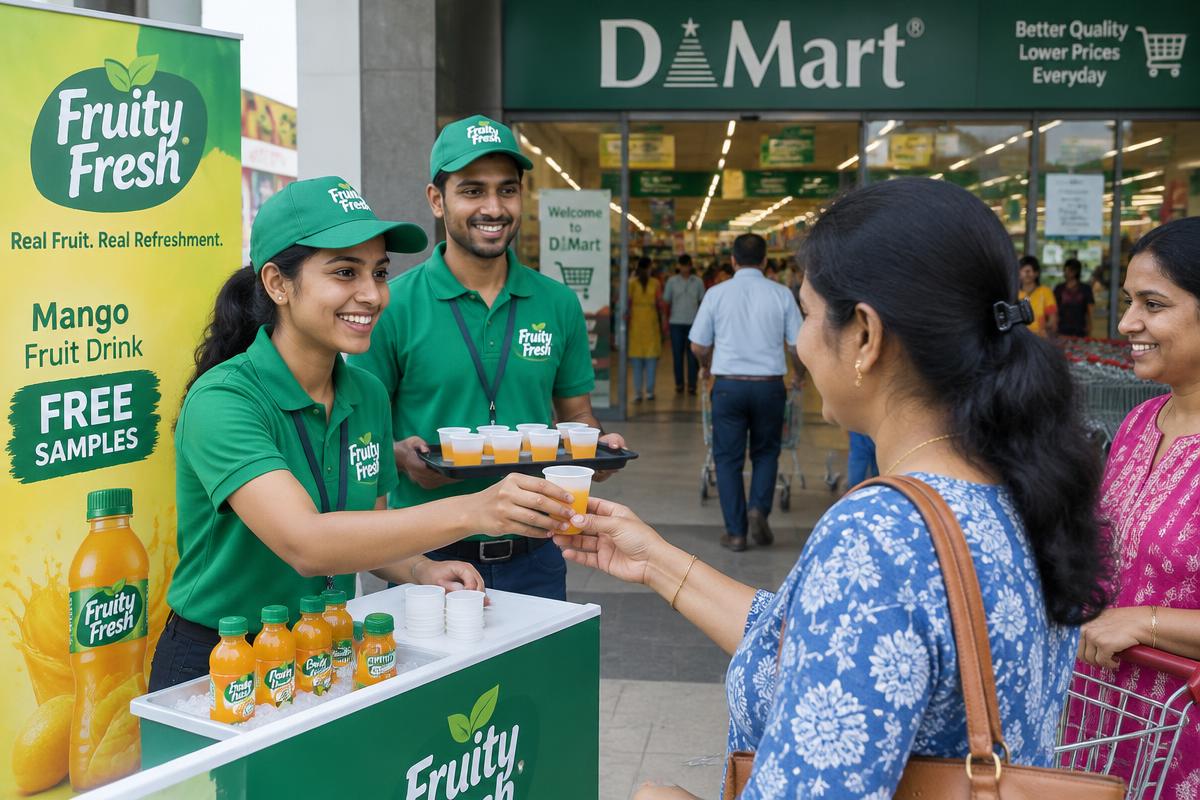
The core format for food and beverage, where tasting is the entire argument. Portioned, single-serve units handed out under food-safety handling at the point of contact.
Apply-and-feel demonstration
For personal care and home care, where the consumer needs to feel a texture or see a result on the spot rather than taste anything.
Gift-with-purchase sampling
A sample bundled with an existing purchase at a retail counter, reaching consumers already inside the category rather than cold footfall.
Society and gated-community sampling
A sampling counter at a society clubhouse or gate under committee permission, reaching households in a setting they already trust.
Coupon or QR-tracked sampling
A sample paired with a redeemable coupon or QR code, so trial can be traced forward into an actual purchase rather than left as an assumption.
Haat and rural sampling
Sampling at a weekly rural market, where one day concentrates the footfall of several surrounding villages for a trial-led category.
Worked example
A costed example you can check
What 12 days of product sampling actually costs
Take a 12-day product sampling programme in Sus, Pune, staffed with 4 people (3 promoters and 1 supervisor), running at a canopy day in a high-street market. Here is the direct cost, computed at tier 1 rates rather than estimated.
| Cost head | Basis | Amount |
|---|---|---|
| Team | 3 promoters and 1 supervisor across 12 activation days, at tier 1 day rates | ₹69,600 |
| Venue & permissions | 12 venue-days at the mid-point of the market canopy band | ₹90,000 |
| Subtotal | Direct costs, excluding GST | ₹1,59,600 |
| GST | At the applicable rate on services | ₹28,728 |
| Total | Indicative, including GST | ₹1,88,328 |
Contacts engaged
6,900
At the mid-point of the planning band
Cost per contact
₹23
Direct cost ÷ contacts
Cost per lead
₹105 – ₹289
At 552–1,518 leads captured
Direct costs only. Fabrication, logistics and reporting are additional and typically add 31% to 58% of the programme budget. GST is shown at 18%. These are indicative planning figures, not a quotation.
Process
How product sampling runs in Sus
- 01Days 1-3
Brief & stock planning
Fix the sample unit size, shelf life and the quantity to issue per location, sized against the engagement band for the chosen venue type.
- 02Days 2-6
Location shortlist & permission
Shortlist locations on audience fit, not footfall alone, and secure market, society or mall permission for the sampling footprint.
- 03Days 5-8
Team training & mock session
Brief promoters on the pitch, the food-safety or handling protocol and the reconciliation process, closing with a scored mock session.
- 04From go-live
Rollout & daily reconciliation
Distribute against a signed-off stock sheet every day, logging contacts, samples issued, samples returned and any expiry or damage.
- 05Weekly
Review & reallocation
Rank locations by trial conversion and move stock away from locations that under-deliver against the plan.
Timing that changes the result
Demand and response peak around February to April — beverages, cooling and travel categories launch here. Book teams, venues and fabrication early for that window, because vendor pricing moves with it.
Measurement
What gets reported, and how
Every campaign reports the same way: attendance against roster, geo-tagged and time-stamped photographs per venue, contacts engaged counted on the capture tool rather than estimated, and leads verified by callback before they are counted. Weak locations show up in the first week, which is the only point at which they can still be fixed.
| Metric | How it is captured |
|---|---|
| Samples distributed against stock issued | Reconciled against stock issued, per venue per day |
| Contacts engaged per promoter per day | Counted on the data-capture tool by promoter and venue, not estimated |
| Trial conversion rate against contacts engaged | Counted on the data-capture tool by promoter and venue, not estimated |
| Coupon or QR redemption rate among sampled consumers | Reconciled against stock issued, per venue per day |
| Wastage and expiry incidents against stock issued | Reconciled against stock issued, per venue per day |
| Locations retained after the first performance review | Recorded daily on the live dashboard, against the agreed target |
Compliance
Permissions in Sus
- FSSAI registration or licence for handling and distributing food samples
- Cold-chain or refrigerated storage for perishable stock
- Stock reconciliation sheet logging issued, distributed, returned and expired units
- Market committee, society or mall permission for the sampling footprint
- Waste disposal for packaging and unconsumed product at the end of each day
What goes wrong
Common product sampling mistakes
- Stock issued with no reconciliation sheet, which hides leakage
- Distributing perishable samples without verified cold-chain, risking spoilage complaints
- Sampling a product that needs explanation without training promoters on the pitch
- No expiry-date check before issue, so ageing stock reaches a consumer
- Treating every location as equal instead of concentrating stock on the ones that convert
FAQ
Product Sampling in Sus: FAQs
How much does product sampling cost in Sus?+
Indicative pricing is ₹15 – ₹60 per contact, at tier 1 rates for the Pune market. The number that actually moves your quote is venue-days and team size, not the area. Sus itself adds no travel loading, because the team is local to Pune.
Do you need permission for product sampling in Sus?+
Yes: FSSAI registration or licence for handling and distributing food samples, Cold-chain or refrigerated storage for perishable stock and Stock reconciliation sheet logging issued, distributed, returned and expired units. In Sus the gating item is usually society committee approval and the weekend slot, and it is targeted at the build date rather than go-live.
How many venues can you cover in Sus?+
As many as Sus genuinely supports — coverage is quoted per venue-day, so the programme scales with the area rather than being sold as a fixed package. Where Sus is smaller, it is usually run together with neighbouring Pune areas on the same crew rotation.
How is a Sus campaign reported?+
Per venue, per day: attendance against roster, geo-tagged and time-stamped photographs, contacts engaged and leads or samples recorded. Sus appears as its own line in the dashboard rather than being folded into a Pune total — which is the only way a weak location is visible early enough to fix.
How many samples should I budget for a sampling programme?+
Size it off the venue's engagement band and a trial rate of 35-60%, not a round number. A 12-day programme at a market canopy running at the engagement band's mid-point of roughly 575 contacts a day works out to about 6,900 contacts for the period; at a 35-60% trial rate that implies somewhere between 2,415 and 4,140 trial conversions to stock against, with the reconciliation sheet catching anything that drifts outside that range.
How is sampling different from in-store promotion?+
Sampling lets the product do the selling through direct trial; in-store promotion uses a trained person to tip a purchase decision that is already in motion at the shelf. The two are often run together, but sampling is justified on its own whenever the core barrier is disbelief in a claim rather than hesitation between options.