Playbook · 11 min read · Updated 2026-10-04
Product Sampling for FMCG: The Complete Playbook
How FMCG brands use product sampling in India — the buyer-to-sale sequence, category-specific KPIs, a week-by-week plan and the cost per qualified lead to expect.
Quick answer
FMCG brands use product sampling to meet buyers in person, demonstrate value and capture a lead that can be qualified rather than just counted. The sequence that works: map where the FMCG buyer actually is, run the format that suits the category, and judge it on qualified leads or sales — never on footfall.
Key takeaways
- Product Sampling gives FMCG buyers the trust that a screen cannot
- Pick venues by buyer profile, not by raw footfall
- A qualified lead here costs an estimated ₹268 — tie the KPI to that number, not to contacts made
- Review the report after the second week and move budget toward whichever venue is already beating the cost-per-qualified-lead target
Step by step
- 1
Map the buyer
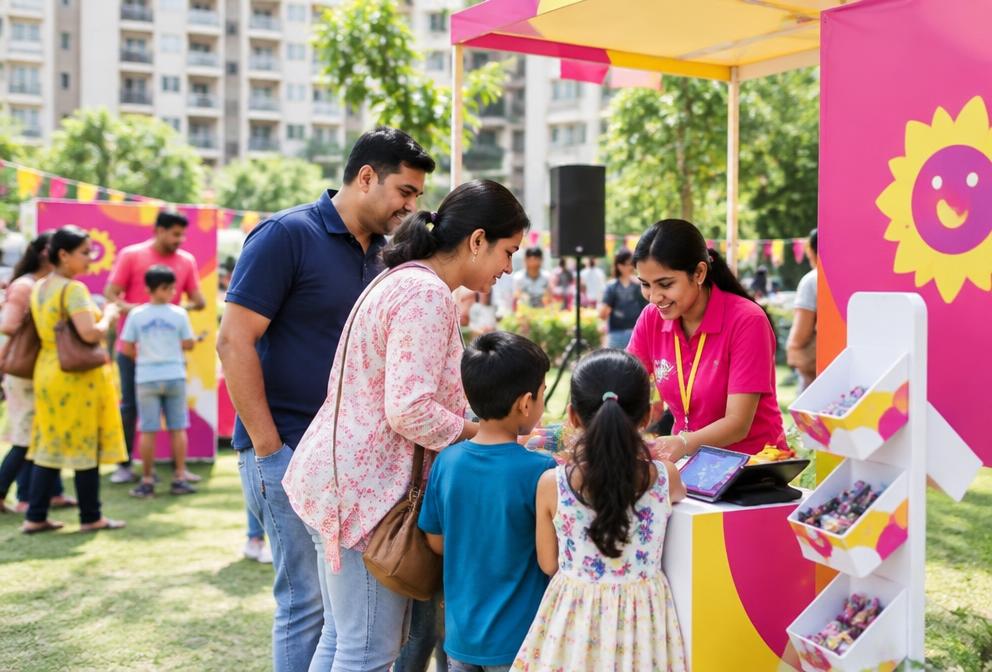
Identify where FMCG buyers actually are — shoppers and passers-by willing to stop for a few seconds of hands-on trial at the exact point where the product is already relevant — and choose venues from market canopies, retail stores, residential societies, haats and melas, mall atriums and petrol pump forecourts that match that profile rather than whichever venue has the highest raw footfall.
- 2
Pick the KPI that matches a sale
FMCG campaigns go wrong when footfall is the scoreboard. Tie the primary number to trial conversion rate against contacts engaged or another metric from the list below that a sale can actually be traced back to.
- 3
Run the format with a trained team
Deploy 3 promoters and 1 supervisor against the formats that fit the category — Taste and trial sampling, Apply-and-feel demonstration and Gift-with-purchase sampling are usually the ones FMCG buyers respond to most directly.
- 4
Tie results back to the pipeline
Match captured leads to CRM records at 30 and 60 days so the campaign is judged on locations retained after the first performance review rather than on how many people stopped at the stall.
Why FMCG brands use product sampling
Drive trial and shelf offtake with sampling, in-store promoters and RWA activations.
A consumer who tastes, feels or watches a product work resolves their own doubt without being argued into it, which is why sampling converts skeptics that advertising alone cannot reach. Because trial is the whole mechanism, the format lives or dies on two disciplines that have nothing to do with the pitch: stock reaching the right hands rather than being idly handed out, and every sample being accounted for so leakage is visible rather than buried in the budget.
None of that is specific to FMCG by accident — the format is chosen for this category precisely because shoppers and passers-by willing to stop for a few seconds of hands-on trial at the exact point where the product is already relevant overlaps closely with where and how FMCG buyers already make their decision.
The buyer-to-sale sequence
The playbook above has four stages, and the order matters: picking the KPI before running the format is what stops an FMCG campaign from being judged on contacts made instead of pipeline moved.
Running the stages out of order is the most common reason a campaign that looked successful on the day produces nothing in the CRM a month later — the team was never told which number it was actually being measured against.
None of the four stages is optional, but the second one — picking the KPI — is the one most often skipped under time pressure, and it is the cheapest of the four to get right because it costs nothing but a decision made before the brief is finalised.
What to measure for FMCG
These are the numbers that should appear on the weekly report, in this rough order of priority.
Reporting all of them every week is less useful than reporting the top one consistently — a dashboard with twelve metrics and no clear owner for any of them is how a campaign drifts without anyone noticing.
- Samples distributed against stock issued
- Contacts engaged per promoter per day
- Trial conversion rate against contacts engaged
- Coupon or QR redemption rate among sampled consumers
- Wastage and expiry incidents against stock issued
- Locations retained after the first performance review
Campaign plan by week
The same stages above map onto a working calendar as follows, using the lead times this format typically needs.
Phases that look sequential on a slide usually overlap in practice — training can start before every permission is in hand, for instance — but the dependency chain in the table below is the one that cannot be compressed without risking the launch date.
| Phase | Window | What happens |
|---|---|---|
| Brief & stock planning | Days 1-3 | Fix the sample unit size, shelf life and the quantity to issue per location, sized against the engagement band for the chosen venue type. |
| Location shortlist & permission | Days 2-6 | Shortlist locations on audience fit, not footfall alone, and secure market, society or mall permission for the sampling footprint. |
| Team training & mock session | Days 5-8 | Brief promoters on the pitch, the food-safety or handling protocol and the reconciliation process, closing with a scored mock session. |
| Rollout & daily reconciliation | From go-live | Distribute against a signed-off stock sheet every day, logging contacts, samples issued, samples returned and any expiry or damage. |
| Review & reallocation | Weekly | Rank locations by trial conversion and move stock away from locations that under-deliver against the plan. |
Formats that resonate in this category
Not every format below performs equally for FMCG; these are the ones most frequently chosen first, broadly in order of how often they are used for this category.
The common thread across them for FMCG is the same mechanism that makes the format work in general — a consumer who tastes, feels or watches a product work resolves their own doubt without being argued into it, which is why sampling converts skeptics that advertising alone cannot reach. Because trial is the whole mechanism, the format lives or dies on two disciplines that have nothing to do with the pitch: stock reaching the right hands rather than being idly handed out, and every sample being accounted for so leakage is visible rather than buried in the budget — applied to a buyer who specifically needs that reassurance before this category's purchase decision.
- Taste and trial sampling — The core format for food and beverage, where tasting is the entire argument. Portioned, single-serve units handed out under food-safety handling at the point of contact.
- Apply-and-feel demonstration — For personal care and home care, where the consumer needs to feel a texture or see a result on the spot rather than taste anything.
- Gift-with-purchase sampling — A sample bundled with an existing purchase at a retail counter, reaching consumers already inside the category rather than cold footfall.
- Society and gated-community sampling — A sampling counter at a society clubhouse or gate under committee permission, reaching households in a setting they already trust.
- Coupon or QR-tracked sampling — A sample paired with a redeemable coupon or QR code, so trial can be traced forward into an actual purchase rather than left as an assumption.
- Haat and rural sampling — Sampling at a weekly rural market, where one day concentrates the footfall of several surrounding villages for a trial-led category.
Worked example: cost per qualified lead
Qualification matters more in some categories than others — a lead that has not been checked is worth less the higher the ticket size of what you are selling.
For FMCG, the gap between a raw lead and a qualified one is usually where the real cost of the campaign is decided, which is why the example below carries the number through both stages rather than stopping at the cheaper, flatter-looking lead count.
FMCG: cost per qualified lead
3 promoters and 1 supervisor over 12 days at a high-street market canopy.
- Contacts engaged
- 6,900
- Leads captured (8%–22% of contacts)
- 1,035
- Leads qualified (45%–70% of leads)
- 595
- Spend, ex-GST
- ₹1,59,600
₹268 per qualified lead — the number to compare against the FMCG deal size, not the per-contact figure that ignores qualification altogether.
Qualification is the gate
Stock issued with no reconciliation sheet, which hides leakage A sales team ignores lead counts that have not been through this gate, which makes an unqualified number worse than useless — it actively damages the credibility of the next campaign's report.
Budget allocation for an industry programme
The same cost structure that applies to any product sampling campaign applies here, but FMCG programmes typically cannot afford to cut the same lines that a lower-stakes category might.
Reporting and tech is usually the smallest line in the table below, and it is also the one FMCG programmes should be most reluctant to trim — the qualification step that makes this category's leads worth anything depends entirely on data capture that a thin reporting budget cannot support.
| Cost head | Share of budget | Why it matters here |
|---|---|---|
| Manpower | 25%–40% | Promoters, supervisors, anchors, training and attendance tracking |
| Fabrication & materials | 20%–35% | Kiosk or stall build, branding, POSM, consumables |
| Venue & permissions | 15%–30% | Space rental, society or mall fees, municipal and police NOCs |
| Logistics | 8%–15% | Transport, storage, setup and dismantling |
| Reporting & tech | 3%–8% | Live dashboard, data capture, geo-tagged photo proof |
Services that pair well
Product Sampling rarely runs alone in an FMCG media plan.
Pairing is less about running more activity and more about covering the stage of the funnel this format does not — a format good at trial is rarely also the best format for the retail visibility or the lead qualification that comes immediately before or after it.
- RWA & Society Activation — Reach families at home through gated society and RWA activations.
- In-Store Promotion — In-store promoters and demos that convert shoppers at shelf.
- Visual Merchandising — Shelf branding, FSUs and visual merchandising that win the aisle.
- Canopy Activation — Branded canopy activations at petrol pumps, markets and haats.
In FMCG, trust is not won with a louder message — it is won with a closer one.
What a second month of the programme should look like
By the second month, the report should be organised around which venues and which formats beat the cost-per-qualified-lead figure above, with budget moved toward them rather than spread evenly across the original list.
An FMCG programme that still treats every venue and format equally after a full month has not been reviewed — it has only been run.
Planning product sampling?
Get an itemised plan and quote from BTL Marketing Co. within 24 hours.
Frequently asked questions
How much does product sampling cost in India?+
Indicative pricing is ₹15 – ₹60 per contact. The final quote moves with the cities chosen, the number of days, team size, fabrication and the permissions each venue needs, so ask for an itemised breakup rather than one lump-sum figure.
How quickly can product sampling go live?+
A single-city pilot can go live in 5–10 working days. A regional rollout across several cities typically needs 14–21 working days once permissions and fabrication are built into the schedule.
Which Indian cities can run product sampling?+
Product Sampling can be planned in any of India's 70 tracked cities, including Mumbai, Delhi, Gurgaon, Noida, Bangalore, Hyderabad, with tier 2 towns quoted on request.
How many samples should I budget for a sampling programme?+
Size it off the venue's engagement band and a trial rate of 35-60%, not a round number. A 12-day programme at a market canopy running at the engagement band's mid-point of roughly 575 contacts a day works out to about 6,900 contacts for the period; at a 35-60% trial rate that implies somewhere between 2,415 and 4,140 trial conversions to stock against, with the reconciliation sheet catching anything that drifts outside that range.
How is sampling different from in-store promotion?+
Sampling lets the product do the selling through direct trial; in-store promotion uses a trained person to tip a purchase decision that is already in motion at the shelf. The two are often run together, but sampling is justified on its own whenever the core barrier is disbelief in a claim rather than hesitation between options.
How do you handle food safety for edible samples?+
Every edible sample is handled under FSSAI registration or licence, with cold-chain or refrigerated storage specified wherever the product needs it. Stock is reconciled daily against issued, distributed, returned and expired quantities, and anything past its shelf life is withdrawn rather than issued.
Is product sampling effective for FMCG?+
Where the sale depends on trust or demonstration, yes — product sampling lets an FMCG buyer see or try something a screen cannot show, which is precisely the mechanism the format relies on.
How is product sampling different for FMCG compared with other categories?+
Mostly in which KPI is primary and how long qualification takes — the format and venues are broadly the same, but FMCG buyers are weighed against samples distributed against stock issued rather than a generic contact count, which changes what counts as a good day on site.
What is the biggest planning mistake specific to FMCG?+
Treating this format's KPI as generic rather than tied to FMCG's own deal size and sales cycle — a contact count that would be a strong result in a low-ticket category can be a weak one here, and the only way to know which is to set the target against this category's numbers before go-live, not against a borrowed one from elsewhere.
Does the team need category-specific training for FMCG?+
Yes, beyond the standard product brief — FMCG buyers ask different questions than a generic shopper does, and a promoter trained only on the product pitch rather than on the category's common objections will lose exactly the conversations this format is meant to win.
Product Sampling in top cities
More on product sampling
- Product Sampling Cost in India: Price Guide & Budget Breakdown
- How to Plan a Product Sampling Campaign: Step-by-Step Guide
- Product Sampling Ideas That Drive Sales: Proven Formats
- Product Sampling vs Digital Ads: Which Delivers Better ROI?
- How to Choose a Product Sampling Agency in India: Vendor Checklist
- Measuring Product Sampling ROI: Formula, Attribution & Worked Example