Pricing · 11 min read · Updated 2026-10-04
On-Ground Activation Cost in India: Price Guide & Budget Breakdown
How much does on-ground activation cost in India? Indicative rates (₹25,000 – ₹5L per location), what drives the price, a worked budget example and ways to cut cost without cutting results.
Quick answer
On-Ground Activation in India typically costs ₹25,000 – ₹5L per location. The quote moves with the cities and venues chosen, the number of days, team size, fabrication and the permission fees each venue charges. GST at 18% is usually added on top of the quoted figure, and a single-city pilot is the cheapest way to prove the numbers before a multi-city commitment.
Key takeaways
- Indicative range: ₹25,000 – ₹5L per location
- Manpower is usually the largest cost head, at 25%–40% of the budget
- Venue and permission fees add another 15%–30%
- A 24-day pilot at a high-street market canopy is the standard way to test a quote before scaling
- Ask for an itemised breakup — GST, venue fees and manpower should each be a separate line
- The same plan costs about ₹1,74,168 less in a tier 2 city than in a tier 1 city
| Cost head | What it covers | Share of budget |
|---|---|---|
| Manpower | Promoters, supervisors, anchors, training and attendance tracking | 25%–40% |
| Fabrication & materials | Kiosk or stall build, branding, POSM, consumables | 20%–35% |
| Venue & permissions | Space rental, society or mall fees, municipal and police NOCs | 15%–30% |
| Logistics | Transport, storage, setup and dismantling | 8%–15% |
| Reporting & tech | Live dashboard, data capture, geo-tagged photo proof | 3%–8% |
What does on-ground activation cost in India?
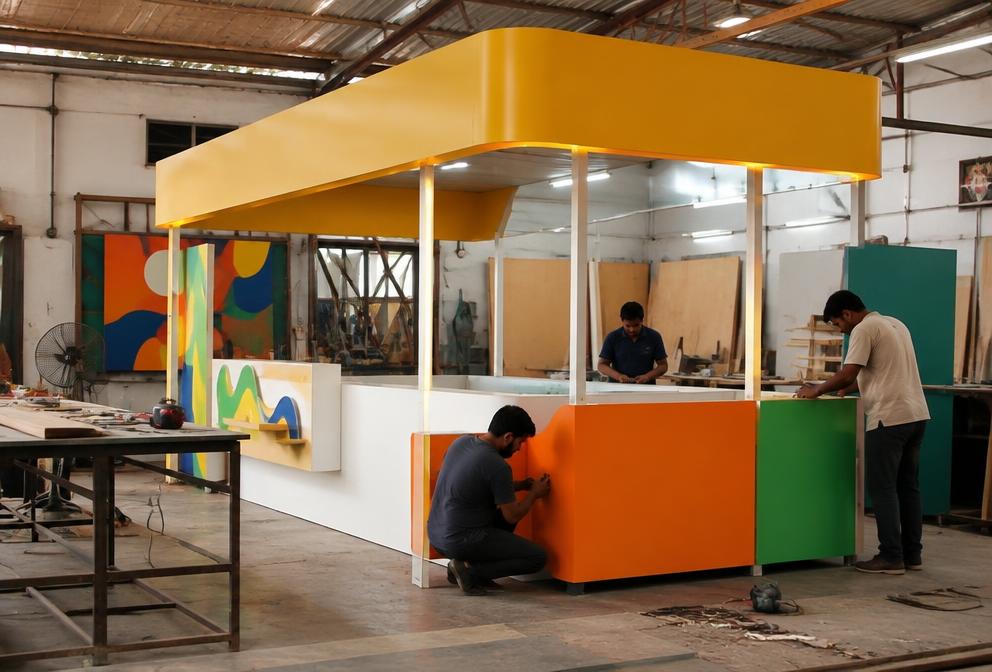
On-ground activation is street-level coverage: the same small format — a stall, a canopy or a kiosk with two or three promoters — repeated across many high-footfall locations such as markets, transit hubs and forecourts, run to one standard operating procedure. The objective is coverage and consistency across locations, not depth of engagement at any single one, which is what separates it from a brand activation built around one venue.
Most brands planning on-ground activation work within ₹25,000 – ₹5L per location. The low end of that range covers a lean, single-location execution with a small team and minimal fabrication; the high end covers multi-city programmes with custom builds, larger rosters and daily reporting built in from day one. Running an identical, low-cost footprint across many locations turns a marketing spend into a dataset: every location reports contacts, leads and cost per contact on the same day, so the weak locations are visible within the first week rather than discovered at the end of the campaign. Because each unit is cheap to set up and tear down, the programme can shed underperforming locations and add more days to the ones that work, improving the average return without changing the format itself.
"₹25,000 – ₹5L per location" is a market range, not a quote for your specific brief — the only way to turn a range into a number you can act on is to fix the venue, the number of days and the team, which is exactly what the sections below do, one variable at a time.
What moves the price most
Four variables decide where a quote lands inside that range: how many market canopies or similar venues are booked, how many days the team runs, how large and senior the roster is, and how custom the fabrication or content is. On-Ground Activation reaches market shoppers, commuters and local residents encountered at high-footfall street-level locations, reached location by location rather than through one large venue, so the venue mix is usually set by where that audience already is rather than by whichever venue type happens to be cheapest to book that week.
None of these five levers move the quote by the same amount, which is why it is worth reading them in order rather than negotiating on whichever one happens to come up first in a call.
- Cities — Mumbai, Delhi, Gurgaon, Noida, Bangalore, Hyderabad price higher than tier 2 towns for the same venue type, purely on venue and manpower rates, with nothing else about the brief changing
- Duration — a weekend pilot costs less per day than a month-long run, because training and setup are one-time costs spread over fewer days
- Team seniority — a roster that includes anchors, senior promoters or technicians costs more per day than a standard promoter roster, and the gap compounds across every day the team is deployed
- Fabrication — a custom build costs several times a modular, reusable one over the life of a campaign, even though the first-city cost can look similar
- Season — September to November — Navratri, Durga Puja, Dussehra and Diwali — the highest-response and highest-cost window of the year
Venue and permission fee bands
On-Ground Activation is typically booked into market canopies, petrol pump forecourts, transit route halt points, haats and melas and retail stores. Each venue type carries its own daily fee band, and that band is usually the most negotiable line in the quote, because it depends on relationship and timing as much as on a published rate card.
A venue quoted at the top of its band in one month can quote closer to the bottom in another, with nothing about the format or the team changing — which is the clearest sign that the fee, not the service, is what is being negotiated.
| Venue type | Tier 1 city | Tier 2 city |
|---|---|---|
| Market canopy | ₹3,000 – ₹12,000 | ₹1,500 – ₹6,000 |
| Petrol pump forecourt | ₹2,500 – ₹10,000 | ₹1,200 – ₹5,000 |
| Transit route halt | ₹2,000 – ₹9,000 | ₹1,000 – ₹4,500 |
| Haat or mela | ₹2,000 – ₹10,000 | ₹1,000 – ₹5,000 |
| Retail store | ₹1,500 – ₹8,000 | ₹800 – ₹4,000 |
Manpower rates that go into the quote
A typical on-ground activation deployment runs with 4 promoters, 1 supervisor and 1 city manager. Day rates are fixed by role and city tier rather than negotiated per campaign, which is what makes a manpower line auditable against the rate card below instead of taken on trust.
Unlike the venue fee, the manpower line does not move with the season — a promoter costs the same to deploy in a quiet month as in a festive one, so a quote that inflates manpower cost during a high-demand window is folding a venue-side premium into the wrong line.
| Role | Tier 1 city | Tier 2 city |
|---|---|---|
| Promoter | ₹1,200 | ₹900 |
| Supervisor | ₹2,200 | ₹1,700 |
| City manager | ₹3,500 | ₹2,800 |
Tier 1 vs tier 2: the same plan, two price points
Moving the identical 24-day plan from a tier 1 city to a tier 2 city saves about ₹1,74,168 on this pilot alone, entirely from lower venue and manpower rates, with the format and team size unchanged.
That makes the city tier one of the few cost levers that does not trade off against quality — a tier 2 city does not get a worse team or a smaller build for the same brief, just a lower rate card.
| Line item | Tier 1 city | Tier 2 city |
|---|---|---|
| Venue & permission fee | ₹1,80,000 | ₹90,000 |
| Manpower | ₹2,52,000 | ₹1,94,400 |
| Subtotal | ₹4,32,000 | ₹2,84,400 |
| Total with 18% GST | ₹5,09,760 | ₹3,35,592 |
Worked example: a 24-day pilot
Here is one realistic configuration, with every figure traceable to the rate cards above so the total can be checked rather than taken on faith.
24 days at a high-street market canopy, tier 1 city
Team: 4 promoters, 1 supervisor and 1 city manager. Venue: a high-street market canopy, at the mid-point of the fee band, for 24 days.
- Venue & permission fee (24 days, mid-band)
- ₹1,80,000
- Manpower (4 promoters, 1 supervisor and 1 city manager, 24 days)
- ₹2,52,000
- Subtotal
- ₹4,32,000
- GST (18%)
- ₹77,760
Total payable: ₹5,09,760, against an estimated 13,800 contacts at this venue — ₹37 per contact, GST included.
Fabrication, travel and consumables are deliberately excluded here because they vary by format — add them as their own lines rather than folding them into the day rate.
How cost changes with scale
A 24-day pilot in one city is the cheapest way to see whether these numbers hold on the ground before committing further. Running the identical plan in three cities roughly triples the venue and manpower lines, to about ₹12,96,000 before GST, while design, permissions liaison and the reporting dashboard are largely one-time costs — which is why cost per contact tends to fall, not rise, as the same format scales to more cities.
Budget 14–21 working days for that regional step, against 5–10 for the single-city pilot, so the pilot itself is timed to leave runway for a second city if the numbers hold up.
A national rollout across ten or more cities typically runs 21–45 working days end to end and is usually where volume discounts on manpower and fabrication start to appear, because a vendor can commit a standing team instead of assembling a fresh one for every city it enters.
Cutting cost without cutting results
The cuts that hurt least are the ones that remove duplicated setup, not the ones that remove training or proof.
Check any vendor's quote against the structure used above: if venue fee, manpower and GST do not separate out this cleanly, ask for the breakup before comparing the total to another agency's number — a lower total is meaningless if it is hiding a missing line.
- Cluster locations so one team and one fabrication set serve several venues without long travel between them
- Book venues three to four weeks ahead of the dates below to avoid last-minute premium rates
- Avoid stacking a first pilot inside September to November unless the on-ground activation is specifically timed to that window
- Reuse modular fabrication across cities instead of commissioning a fresh build for each one
- Separate statutory fees from society or mall commercial fees in the quote, since only the commercial fee is usually negotiable
Rule of thumb
Venue and permission fees usually land between 15% and 30% of the total. If a quote shows this line at half that share, the fee is probably being billed separately at actuals later — ask directly before signing.
A quote for on-ground activation with one line item is not a quote — it is a guess with a rupee sign in front of it.
Planning on-ground activation?
Get an itemised plan and quote from BTL Marketing Co. within 24 hours.
Frequently asked questions
How much does on-ground activation cost in India?+
Indicative pricing is ₹25,000 – ₹5L per location. The final quote moves with the cities chosen, the number of days, team size, fabrication and the permissions each venue needs, so ask for an itemised breakup rather than one lump-sum figure.
How quickly can on-ground activation go live?+
A single-city pilot can go live in 5–10 working days. A regional rollout across several cities typically needs 14–21 working days once permissions and fabrication are built into the schedule.
Which Indian cities can run on-ground activation?+
On-Ground Activation can be planned in any of India's 70 tracked cities, including Mumbai, Delhi, Gurgaon, Noida, Bangalore, Hyderabad, with tier 2 towns quoted on request.
How is on-ground activation different from a brand activation?+
On-ground activation repeats the same small, low-cost format across many locations and is judged on coverage and cost per contact. A brand activation builds one larger, more designed experience at a single venue and is judged on engagement depth. Many programmes run both: on-ground activation to find where the audience is, brand activation once a venue is worth investing in.
How many locations should a programme run at once?+
Deliberately more than the number you expect to keep. Locations are over-listed at the start, run for one to two weeks, and ranked by cost per contact, with the weakest tier dropped and those days reallocated to whatever is actually working.
How is coverage verified across so many locations at once?+
Geo-tagged setup photos and a same-day report filed per location, not a weekly or campaign-end summary. Daily reporting is what makes a skipped or shortened location visible immediately rather than discovered after the budget is spent.
Does team size change the per-contact cost of on-ground activation?+
Yes, in both directions. A larger team raises the manpower line but can raise contacts enough to lower cost per contact; a team too small for the venue raises cost per contact because the venue fee is paid either way while fewer contacts are made. The team sizing in the worked example above is the starting point for finding that balance, not a fixed rule.
Is GST included in on-ground activation quotes?+
Most agency quotes are exclusive of 18% GST, added at invoicing. Confirm separately whether venue fees and permissions are quoted at a fixed figure or billed at actuals, since both practices exist.
What is the cheapest way to try on-ground activation?+
A 24-day pilot at the lowest-cost venue in your mix, with a lean team and no custom fabrication, is the standard way to see real numbers before committing a larger budget — the worked example above shows what that costs at a tier 1 rate, and a tier 2 city brings it down further still.
Why do two agencies quote different prices for the same on-ground activation brief?+
Usually because one of the five levers in this guide is set differently, not because one agency is simply cheaper. Ask each one to map its quote against venue fee, manpower, fabrication, logistics and GST before comparing totals — a 20% gap with no visible difference in team size, days or venue is the one worth questioning directly.
On-Ground Activation in top cities
More on on-ground activation
- How to Plan a On-Ground Activation Campaign: Step-by-Step Guide
- On-Ground Activation Ideas That Drive Sales: Proven Formats
- On-Ground Activation vs Digital Ads: Which Delivers Better ROI?
- How to Choose a On-Ground Activation Agency in India: Vendor Checklist
- On-Ground Activation for Consumer Brands: The Complete Playbook
- Measuring On-Ground Activation ROI: Formula, Attribution & Worked Example