Guide · 10 min read · Updated 2026-10-04
How to Plan a LED Van Campaign Campaign: Step-by-Step Guide
A practical, sequenced guide to planning LED van campaign in India — objectives, locations, permissions, team training, live reporting and what to measure before you scale.
Quick answer
To plan LED van campaign: fix one measurable objective, pick venues where your audience already is, secure permissions in the 3–15 working days they typically need, train the team before day one, run with daily reporting, then scale only the locations that beat your cost-per-outcome target.
Key takeaways
- One objective, one primary KPI, decided before the venue is booked
- Permissions are the critical path, not a parallel task
- Train and mock-pitch the team before day one, not on it
- Report daily; review and reallocate weekly
Step by step
- 1
Content & loop build (Days 1-5)
Cut the video for a screen watched from a distance with ambient noise: large type, high contrast, message in the first five seconds, and a local-language audio track.
- 2
Route & halt clearance (Days 3-10)
Fix halts where people genuinely stop, and secure traffic, municipal and amplified-sound permissions with the timing windows attached.
- 3
Vehicle prep & test (Days 8-12)
Fit the screen, test brightness in daylight and after dark, and confirm the generator carries both screen and sound without browning out.
- 4
Campaign run (From go-live)
Run the route with GPS tracking, logging screening hours and geo-tagged photos per halt rather than only distance covered.
- 5
Review (Weekly)
Reallocate screening hours to the halts that gathered real audiences and drop the ones the audience walked past.
What is LED van campaign?
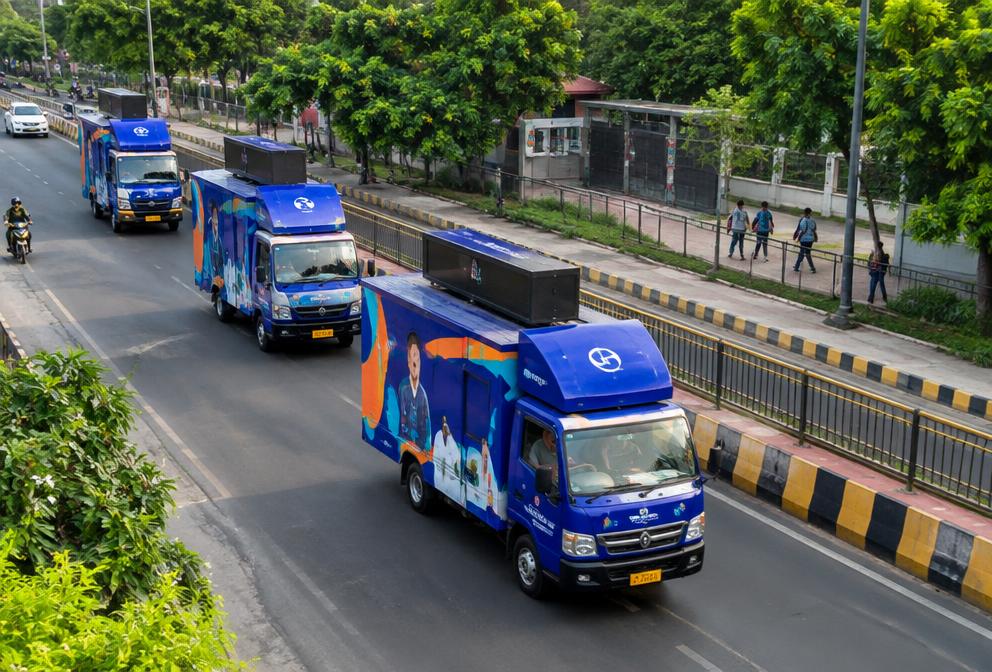
An LED van is a vehicle carrying a large screen that plays video at halt points or along a slow route. It is an awareness and announcement format: it broadcasts rather than converses, which makes it well suited to launches, public information, scheme communication and election-style messaging where the job is to reach many people with one message.
A bright moving screen earns attention in environments where a static poster is ignored, and it carries sound and motion that a hoarding cannot. The trade-off is that it creates very little conversation, so it works best paired with a ground team that can convert the attention it generates into contacts.
Most media plans treat it as one line inside a bigger BTL programme rather than a standalone channel, which is why the steps below assume it is being planned alongside at least one other touchpoint rather than in isolation.
Who it reaches, and where
LED Van Campaign reaches market crowds, residential clusters, commuters and outdoor event audiences At the venue level, a van route day across four to six halt points typically produces somewhere in the 300–1,200 contact range — a planning assumption for sizing the team and stock, never a promise.
Different venue types in the list below are not interchangeable stand-ins for each other; each one reaches a different slice of the audience at a different volume, which is why the venue mix should be chosen from this list rather than defaulted to whichever location is easiest to book.
- Transit route halt — 300–1,200 contacts on a typical day
- Market canopy — 250–900 contacts on a typical day
- Haat or mela — 600–2,500 contacts on a typical day
When to run it
Response and cost both move with the calendar. For LED van campaign, the window that matters most is September to November — Navratri, Durga Puja, Dussehra and Diwali — the highest-response and highest-cost window of the year
Running outside that window does not make the format ineffective, but it does change what a realistic target looks like, and a plan built on the wrong season's numbers reads as underperformance that is really just a mismatched calendar.
The lead times below are working days, not calendar days, and they assume the brief does not change mid-process — a venue swap or a last-minute city addition resets the clock on whichever row it touches, which is the single most common reason a quoted timeline slips.
| Rollout | Working days needed |
|---|---|
| Permissions alone | 3–15 |
| Single-city pilot | 5–10 |
| Custom fabrication | 10–25 |
| Regional rollout | 14–21 |
| National rollout | 21–45 |
Formats to choose from
A complete brief should name the format before it names the venue. The formats below cover most briefs for LED van campaign; pick one or two to pilot rather than trying all of them at once.
Running more than two formats in a first pilot is rarely a sign of ambition — it is usually a sign that the objective in step one was never actually narrowed down.
- Static-halt LED screening — The van parks at a cleared halt and runs the content loop to a gathered audience. Highest dwell time and the only format where a ground team can realistically convert attention.
- Slow-drive route — The screen plays while the vehicle moves slowly along a busy corridor, trading dwell time for raw reach.
- Event perimeter screen — The van acts as supplementary screen and sound at an outdoor event, match screening or public gathering.
- Announcement circuit — A repeating route through residential and market areas for public information or scheme awareness, usually with a local-language audio track.
- Paired van and ground team — An LED van plus promoters at the halt, so the screen gathers the crowd and the team captures contacts. The only configuration that produces measurable leads.
What a pilot like this should produce
Before the team goes live, write down what the numbers above should produce — it is the only way to tell on day three whether the campaign is underperforming or the plan was wrong.
Expected output of the 15-day pilot
11,250 contacts at a transit route halt point, converted through the planning ranges in figures.ts.
- Contacts engaged
- 11,250
- Leads captured (8%–22% of contacts, mid-point)
- 1,688
- Leads qualified (45%–70% of leads, mid-point)
- 971
At a ₹1,89,000 ex-GST budget, that is ₹112 per lead before any lead has been verified as a sale.
Treat these as planning ranges to size the team and stock against, not as a guarantee — the actual report should replace every one of these numbers with what was measured.
Reviewing the pilot before you scale it
A pilot exists to be reviewed, not just run. Compare the actual numbers against the example above stage by stage — contacts, then leads, then qualified leads — rather than only at the final cost-per-lead figure, because the stage where the real number diverges from the plan is what tells you what to fix.
A shortfall at the contacts stage points at the venue or the day; a shortfall at the leads stage, with contacts on target, points at the pitch or the team; and only a shortfall at the qualified stage, with the first two on target, is actually about lead quality rather than lead volume.
Staffing the pilot correctly
The team sizing used above — 2 promoters, 1 supervisor and 1 technician — is not arbitrary; it follows a ratio that keeps someone accountable for the venue rather than spreading a roster thin across more ground than it can cover.
Understaffing a venue is the fastest way to turn a sound plan into a disappointing report, because a thin team cannot both hold a pitch and capture data at volume — under pressure, data capture is usually the one that gets dropped first, and it is the one the report depends on.
Overstaffing has its own cost, just a quieter one: a team larger than the venue's contact volume can support simply raises the manpower line without raising the contacts, leads or qualified leads it is measured against.
Permissions and compliance to plan for
The biggest single risk in LED van campaign is permissions and compliance slipping the launch date, not the creative or the team.
Each item on the list below sits with a different authority or counterparty, and they rarely move in parallel — a missing document for one often blocks the filing for the next, which is why the sequence matters as much as the list.
- Traffic police clearance for the route and every halt
- Amplified-sound permission with its timing restrictions observed
- Municipal permission for temporary occupation at halts
- Content clearance where messaging is political or statutory
- Generator safety, earthing and fuel handling
Work backwards from the build date
Permissions alone typically take 3–15 working days. File from the build date backwards, not the go-live date forwards, or the schedule looks fine right up until it is not.
Mistakes that sink the plan
Most of the failures below are not creative failures — they are planning failures that show up on site.
Each one is specific enough to check against your own plan directly, which is the point — a generic warning to "plan carefully" has never once prevented any of these from happening.
- Content designed for a phone screen, unreadable at van distance in daylight
- Measuring distance covered instead of screening hours delivered
- Running an LED van with no ground team and then expecting leads
- Ignoring sound-timing restrictions and losing the permission mid-campaign
- Undersized generator, so the screen dims when the sound system loads
The brands that lose their LED van campaign launch date almost always lose it to a permission, not to the weather.
What to measure before you call it a success
Pick one of these as the primary KPI before go-live; the rest are context, not the scoreboard.
Writing the primary KPI down before the venue is booked is what stops a mid-campaign redefinition of success — the temptation to report the number that looks best is strongest exactly when the chosen one is underperforming.
A second, smaller campaign measured against a different primary KPI than the first is not comparable to it, however similar the two look on paper — decide the metric once, early, and keep it fixed across every pilot you want to compare against this one.
- Halt points and screening hours completed
- Estimated audience reached per halt
- Content loop plays delivered against plan
- Contacts captured where a ground team is paired
- GPS-verified route and halt compliance
- Cost per screening hour
Planning LED van campaign?
Get an itemised plan and quote from BTL Marketing Co. within 24 hours.
Frequently asked questions
How much does LED van campaign cost in India?+
Indicative pricing is ₹8,000 – ₹20,000 per day. The final quote moves with the cities chosen, the number of days, team size, fabrication and the permissions each venue needs, so ask for an itemised breakup rather than one lump-sum figure.
How quickly can LED van campaign go live?+
A single-city pilot can go live in 5–10 working days. A regional rollout across several cities typically needs 14–21 working days once permissions and fabrication are built into the schedule.
Which Indian cities can run LED van campaign?+
LED Van Campaign can be planned in any of India's 70 tracked cities, including Mumbai, Delhi, Gurgaon, Noida, Bangalore, Hyderabad, with tier 2 towns quoted on request.
Does an LED van generate leads?+
Not on its own. It is a broadcast format that earns attention but holds very little conversation. Pairing the van with two or three promoters at each halt is what turns that attention into captured contacts, and it is the only configuration worth measuring on leads.
How should the content be cut for an LED van?+
For viewing at distance in daylight with ambient noise: large type, high contrast, the message inside the first five seconds, and an audio track in the local language. Repurposed social-media video almost always fails this test.
Is a static halt or a moving route better?+
Static halts, in nearly every case. A parked van gives dwell time, lets a ground team work, and produces a measurable audience. A slow-drive route buys raw reach and very little else.
How long does a LED van campaign pilot take from brief to report?+
Count 3–15 working days for permissions, running in parallel with sourcing and training, then the activation days themselves, then a short review window — a single-city pilot typically closes inside the 5–10 working-day window quoted for it.
What is the most common reason a LED van campaign pilot underperforms?+
An objective that was never narrowed to one measurable KPI before the venue was booked. Everything downstream — which format, which venue, how the team is briefed — is easy to get right once the objective is specific, and hard to get right by accident when it is not.
Can the same team run more than one venue in a day?+
Only if the venues are close enough that travel time does not eat into the activation window, and only with a supervisor at each location — a team that splits across venues with no one accountable at either one tends to lose the thing this guide is built around: a trained pitch and reliable data capture.
What should change between the first pilot and the second city?+
Whatever the first pilot's report actually showed, not a generic assumption of what should work better. A second city run on exactly the same plan as the first is a second data point; a second city run on a plan that was never updated by the first pilot's findings has wasted the entire point of piloting.
LED Van Campaign in top cities
More on LED van campaign
- LED Van Campaign Cost in India: Price Guide & Budget Breakdown
- LED Van Campaign Ideas That Drive Sales: Proven Formats
- LED Van Campaign vs Digital Ads: Which Delivers Better ROI?
- How to Choose a LED Van Campaign Agency in India: Vendor Checklist
- LED Van Campaign for Government & PSU: The Complete Playbook
- Measuring LED Van Campaign ROI: Formula, Attribution & Worked Example