Pricing · 11 min read · Updated 2026-10-04
Exhibition & Stall Design Cost in India: Price Guide & Budget Breakdown
How much does exhibition & stall design cost in India? Indicative rates (₹9,000 – ₹25,000 per sq m), what drives the price, a worked budget example and ways to cut cost without cutting results.
Quick answer
Exhibition & Stall Design in India typically costs ₹9,000 – ₹25,000 per sq m. The quote moves with the cities and venues chosen, the number of days, team size, fabrication and the permission fees each venue charges. GST at 18% is usually added on top of the quoted figure, and a single-city pilot is the cheapest way to prove the numbers before a multi-city commitment.
Key takeaways
- Indicative range: ₹9,000 – ₹25,000 per sq m
- Manpower is usually the largest cost head, at 25%–40% of the budget
- Venue and permission fees add another 15%–30%
- A 5-day pilot at a corporate park is the standard way to test a quote before scaling
- Ask for an itemised breakup — GST, venue fees and manpower should each be a separate line
- The same plan costs about ₹1,12,100 less in a tier 2 city than in a tier 1 city
| Cost head | What it covers | Share of budget |
|---|---|---|
| Manpower | Promoters, supervisors, anchors, training and attendance tracking | 25%–40% |
| Fabrication & materials | Kiosk or stall build, branding, POSM, consumables | 20%–35% |
| Venue & permissions | Space rental, society or mall fees, municipal and police NOCs | 15%–30% |
| Logistics | Transport, storage, setup and dismantling | 8%–15% |
| Reporting & tech | Live dashboard, data capture, geo-tagged photo proof | 3%–8% |
What does exhibition & stall design cost in India?
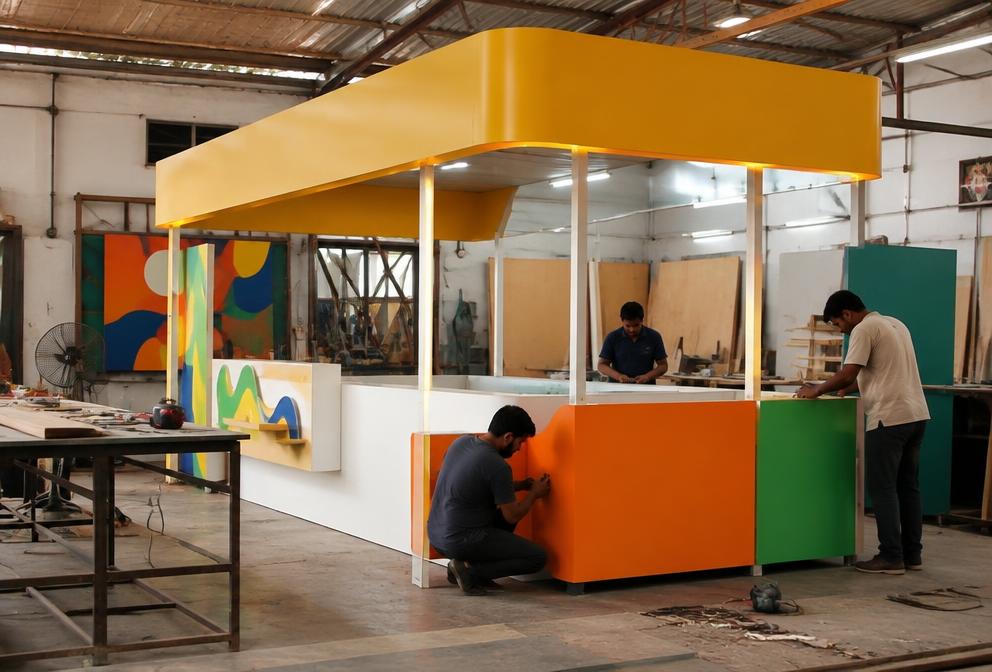
Exhibition stall design is the planning discipline that happens before anything is built: turning a brief and a floor plan into a zoned layout, a visitor-flow plan and a dimensioned fabrication drawing. It decides what gets built and why, which is different from the physical build itself and from the 3D visuals used to approve it along the way.
Most brands planning exhibition & stall design work within ₹9,000 – ₹25,000 per sq m. The low end of that range covers a lean, single-location execution with a small team and minimal fabrication; the high end covers multi-city programmes with custom builds, larger rosters and daily reporting built in from day one. A visitor reads a stall in the few seconds it takes to walk past the aisle, so design controls the only things that matter in that window — what is visible from outside, where the counter sits relative to the approach, and whether the layout invites someone in or makes them keep walking. A decision caught at drawing stage costs a redline; the same decision caught on the show floor costs a rebuild.
"₹9,000 – ₹25,000 per sq m" is a market range, not a quote for your specific brief — the only way to turn a range into a number you can act on is to fix the venue, the number of days and the team, which is exactly what the sections below do, one variable at a time.
What moves the price most
Four variables decide where a quote lands inside that range: how many corporate parks or similar venues are booked, how many days the team runs, how large and senior the roster is, and how custom the fabrication or content is. Exhibition & Stall Design reaches exhibitors who need a stall designed around visitor flow and organiser rules before a fabricator is appointed or a drawing is submitted, so the venue mix is usually set by where that audience already is rather than by whichever venue type happens to be cheapest to book that week.
None of these five levers move the quote by the same amount, which is why it is worth reading them in order rather than negotiating on whichever one happens to come up first in a call.
- Cities — Mumbai, Delhi, Gurgaon, Noida, Bangalore, Hyderabad price higher than tier 2 towns for the same venue type, purely on venue and manpower rates, with nothing else about the brief changing
- Duration — a weekend pilot costs less per day than a month-long run, because training and setup are one-time costs spread over fewer days
- Team seniority — a roster that includes anchors, senior promoters or technicians costs more per day than a standard promoter roster, and the gap compounds across every day the team is deployed
- Fabrication — a custom build costs several times a modular, reusable one over the life of a campaign, even though the first-city cost can look similar
- Season — September to November — Navratri, Durga Puja, Dussehra and Diwali — the highest-response and highest-cost window of the year
Venue and permission fee bands
Exhibition & Stall Design is typically booked into corporate parks, mall atriums and college campuses. Each venue type carries its own daily fee band, and that band is usually the most negotiable line in the quote, because it depends on relationship and timing as much as on a published rate card.
A venue quoted at the top of its band in one month can quote closer to the bottom in another, with nothing about the format or the team changing — which is the clearest sign that the fee, not the service, is what is being negotiated.
| Venue type | Tier 1 city | Tier 2 city |
|---|---|---|
| Corporate park | ₹10,000 – ₹50,000 | ₹5,000 – ₹20,000 |
| Mall atrium | ₹25,000 – ₹1,50,000 | ₹12,000 – ₹55,000 |
| College campus | ₹15,000 – ₹75,000 | ₹8,000 – ₹35,000 |
Manpower rates that go into the quote
A typical exhibition & stall design deployment runs with 2 technicians and 1 supervisor. Day rates are fixed by role and city tier rather than negotiated per campaign, which is what makes a manpower line auditable against the rate card below instead of taken on trust.
Unlike the venue fee, the manpower line does not move with the season — a promoter costs the same to deploy in a quiet month as in a festive one, so a quote that inflates manpower cost during a high-demand window is folding a venue-side premium into the wrong line.
| Role | Tier 1 city | Tier 2 city |
|---|---|---|
| Technician | ₹2,500 | ₹2,000 |
| Supervisor | ₹2,200 | ₹1,700 |
Tier 1 vs tier 2: the same plan, two price points
Moving the identical 5-day plan from a tier 1 city to a tier 2 city saves about ₹1,12,100 on this pilot alone, entirely from lower venue and manpower rates, with the format and team size unchanged.
That makes the city tier one of the few cost levers that does not trade off against quality — a tier 2 city does not get a worse team or a smaller build for the same brief, just a lower rate card.
| Line item | Tier 1 city | Tier 2 city |
|---|---|---|
| Venue & permission fee | ₹1,50,000 | ₹62,500 |
| Manpower | ₹36,000 | ₹28,500 |
| Subtotal | ₹1,86,000 | ₹91,000 |
| Total with 18% GST | ₹2,19,480 | ₹1,07,380 |
Worked example: a 5-day pilot
Here is one realistic configuration, with every figure traceable to the rate cards above so the total can be checked rather than taken on faith.
5 days at a corporate park, tier 1 city
Team: 2 technicians and 1 supervisor. Venue: a corporate park, at the mid-point of the fee band, for 5 days.
- Venue & permission fee (5 days, mid-band)
- ₹1,50,000
- Manpower (2 technicians and 1 supervisor, 5 days)
- ₹36,000
- Subtotal
- ₹1,86,000
- GST (18%)
- ₹33,480
Total payable: ₹2,19,480, against an estimated 2,250 contacts at this venue — ₹98 per contact, GST included.
Fabrication, travel and consumables are deliberately excluded here because they vary by format — add them as their own lines rather than folding them into the day rate.
How cost changes with scale
A 5-day pilot in one city is the cheapest way to see whether these numbers hold on the ground before committing further. Running the identical plan in three cities roughly triples the venue and manpower lines, to about ₹5,58,000 before GST, while design, permissions liaison and the reporting dashboard are largely one-time costs — which is why cost per contact tends to fall, not rise, as the same format scales to more cities.
Budget 14–21 working days for that regional step, against 5–10 for the single-city pilot, so the pilot itself is timed to leave runway for a second city if the numbers hold up.
A national rollout across ten or more cities typically runs 21–45 working days end to end and is usually where volume discounts on manpower and fabrication start to appear, because a vendor can commit a standing team instead of assembling a fresh one for every city it enters.
Cutting cost without cutting results
The cuts that hurt least are the ones that remove duplicated setup, not the ones that remove training or proof.
Check any vendor's quote against the structure used above: if venue fee, manpower and GST do not separate out this cleanly, ask for the breakup before comparing the total to another agency's number — a lower total is meaningless if it is hiding a missing line.
- Cluster locations so one team and one fabrication set serve several venues without long travel between them
- Book venues three to four weeks ahead of the dates below to avoid last-minute premium rates
- Avoid stacking a first pilot inside September to November unless the exhibition & stall design is specifically timed to that window
- Reuse modular fabrication across cities instead of commissioning a fresh build for each one
- Separate statutory fees from society or mall commercial fees in the quote, since only the commercial fee is usually negotiable
Rule of thumb
Venue and permission fees usually land between 15% and 30% of the total. If a quote shows this line at half that share, the fee is probably being billed separately at actuals later — ask directly before signing.
A quote for exhibition & stall design with one line item is not a quote — it is a guess with a rupee sign in front of it.
Planning exhibition & stall design?
Get an itemised plan and quote from BTL Marketing Co. within 24 hours.
Frequently asked questions
How much does exhibition & stall design cost in India?+
Indicative pricing is ₹9,000 – ₹25,000 per sq m. The final quote moves with the cities chosen, the number of days, team size, fabrication and the permissions each venue needs, so ask for an itemised breakup rather than one lump-sum figure.
How quickly can exhibition & stall design go live?+
A single-city pilot can go live in 5–10 working days. A regional rollout across several cities typically needs 14–21 working days once permissions and fabrication are built into the schedule.
Which Indian cities can run exhibition & stall design?+
Exhibition & Stall Design can be planned in any of India's 70 tracked cities, including Mumbai, Delhi, Gurgaon, Noida, Bangalore, Hyderabad, with tier 2 towns quoted on request.
What is the difference between stall design and stall fabrication?+
Design decides the layout, dimensions, materials and the compliance drawing; fabrication is the physical build carried out from that drawing. Buying them from the same team removes the handover gap where a design intention gets lost or re-interpreted by a builder who was not part of the brief.
How many design revisions are normal before a drawing is locked?+
A small number of structured rounds, each tied to one decision — zoning first, then materials, then organiser compliance — rather than open-ended revisions that never converge. A round that tries to decide layout and finishes at the same time is usually the one that drags.
Can the same stall design be reused across multiple shows?+
Only if it is designed as modular from the start, with joints and panels sized to flat-pack and travel. A design drawn as a one-off custom build cannot be retrofitted into a reusable one afterwards without redrawing it.
What happens if the organiser rejects the compliance drawing?+
It is resubmitted against the specific rule it failed — usually height, rigging or rear-wall depth — and caught at this stage it costs a drawing revision. The same rule discovered after fabrication has started costs a rebuild and the organiser can still refuse the stall entry.
Does team size change the per-contact cost of exhibition & stall design?+
Yes, in both directions. A larger team raises the manpower line but can raise contacts enough to lower cost per contact; a team too small for the venue raises cost per contact because the venue fee is paid either way while fewer contacts are made. The team sizing in the worked example above is the starting point for finding that balance, not a fixed rule.
Is GST included in exhibition & stall design quotes?+
Most agency quotes are exclusive of 18% GST, added at invoicing. Confirm separately whether venue fees and permissions are quoted at a fixed figure or billed at actuals, since both practices exist.
What is the cheapest way to try exhibition & stall design?+
A 5-day pilot at the lowest-cost venue in your mix, with a lean team and no custom fabrication, is the standard way to see real numbers before committing a larger budget — the worked example above shows what that costs at a tier 1 rate, and a tier 2 city brings it down further still.
Why do two agencies quote different prices for the same exhibition & stall design brief?+
Usually because one of the five levers in this guide is set differently, not because one agency is simply cheaper. Ask each one to map its quote against venue fee, manpower, fabrication, logistics and GST before comparing totals — a 20% gap with no visible difference in team size, days or venue is the one worth questioning directly.
Exhibition & Stall Design in top cities
More on exhibition & stall design
- How to Plan a Exhibition & Stall Design Campaign: Step-by-Step Guide
- Exhibition & Stall Design Ideas That Drive Sales: Proven Formats
- Exhibition & Stall Design vs Digital Ads: Which Delivers Better ROI?
- How to Choose a Exhibition & Stall Design Agency in India: Vendor Checklist
- Exhibition & Stall Design for Consumer Brands: The Complete Playbook
- Measuring Exhibition & Stall Design ROI: Formula, Attribution & Worked Example