Checklist · 11 min read · Updated 2026-10-04
How to Choose a Kiosk Activation Agency in India: Vendor Checklist
Hiring a kiosk activation agency? A step-by-step vetting process, the questions to ask, red-flag answers, and what a transparent quote should look like before you sign.
Quick answer
Choose a kiosk activation agency that owns permissions and training in-house, reports daily with geo-tagged proof, and gives an itemised quote that matches the rate-card structure below — not a single lump-sum figure. Run a paid pilot before any multi-city or annual contract.
Key takeaways
- In-house permissions, training and fabrication reduce handoff risk between vendors
- Demand daily, geo-tagged reporting — not a single report at campaign end
- An itemised quote should separate manpower, venue fees, fabrication, logistics and GST
- Start with a paid pilot before signing a national or annual contract
- Score every shortlisted agency against the same checklist, not against each other's pitch decks
Step by step
- 1
Share a written brief, not a conversation
Put the objective, cities, dates and budget range in writing before asking for a quote, so every agency is quoting against the same brief rather than against whatever it assumed you meant.
- 2
Score the quote on structure, not just the total
A credible quote breaks into manpower, venue/permission fees, fabrication, logistics and GST as separate lines — close to the breakdown in the worked example below. A single number with no structure is the most common way a quote looks cheaper than it actually is.
- 3
Verify who owns permissions
Ask whether Mall or park space agreement including tenancy duration and security deposit is handled by the agency's own team or sub-contracted — sub-contracted approvals are where schedules slip.
- 4
Inspect the training and verification process
Ask to see a sample training deck and how identity verification is recorded for the people who will be deployed.
- 5
Confirm the reporting method before day one
Insist on geo-tagged, time-stamped photos and a daily dashboard, not a single wrap-up report at the end of the campaign.
- 6
Run a paid pilot
A 20-day pilot at one venue is enough to test attendance, reporting discipline and whether the quoted numbers hold on the ground. Treat the pilot itself as a vetting tool, not just a campaign — how it was run tells you more than the pitch did.
- 7
Lock escalation and replacement terms
Agree in writing what happens to billing and timelines if a promoter no-shows or a permission is delayed, before either happens. A vendor confident in its own operations will not resist writing this down; one that is not will ask to handle it "case by case" when it comes up.
Why the agency matters as much as the format
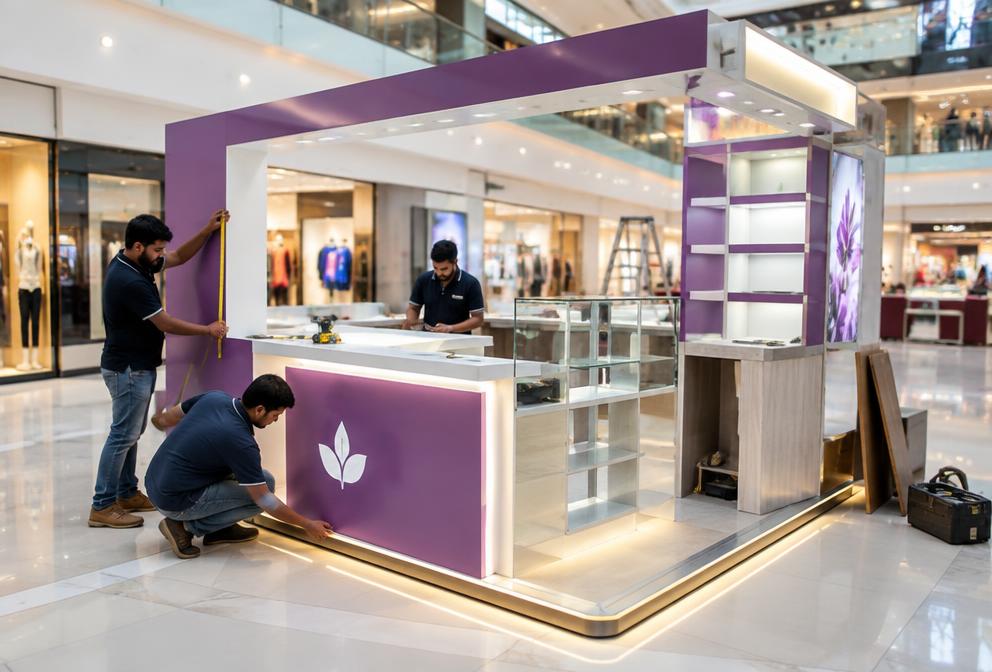
A kiosk activation is a fixed branded structure that holds one location — inside a mall, a corporate park or a campus — for weeks rather than a single day, giving a brand repeated exposure to the same catchment instead of a one-time event footprint. Unlike a canopy that is set up and struck daily, a kiosk stays put, which changes both its economics and what it is actually judged on.
Choosing the wrong agency does not just raise cost — it changes whether kiosk activation works at all, because the format's results depend entirely on execution discipline that a brand cannot see from a deck.
Every item in the checklist below exists because it has gone wrong often enough to be worth checking in advance, not because it sounds thorough on a page.
The checklist
- Evidence of past execution in your category, not just a generic capability deck
- Coverage in your target cities (for example Mumbai, Delhi, Gurgaon, Noida, Bangalore, Hyderabad)
- In-house permissions and liaison team, not a sub-contracted one
- In-house or owned fabrication, with a prototype sign-off step before a full production run
- Trained, identity-verified manpower with attendance tracked against a roster
- Live dashboards with geo-tagged photo proof, available daily, not only at campaign close
- An itemised, transparent quotation with GST shown separately
- A clear escalation and replacement plan for no-shows and delayed permissions
- Written terms on who owns the captured lead data
- Willingness to run a paid pilot before a multi-city contract
How to score competing proposals against this list
Scoring every agency against the same ten-point list, rather than against each other's pitch decks, is what keeps the comparison fair.
A simple yes/no/partial score against each line, totalled across two or three shortlisted vendors, turns an impression-based decision into one that can be defended afterwards if the choice is ever questioned.
Questions to ask, and the answer that should worry you
Each of these is a direct question with a yes-or-no answer. A vendor that needs several sentences to answer a yes-or-no question is usually telling you the answer is no.
| Question to ask | Red-flag answer |
|---|---|
| Can I see last week's geo-tagged reports from a live campaign? | "We'll send a summary at the end" — reporting only at close hides a shortfall until it is too late to fix |
| Who files the Mall or park space agreement including tenancy duration and security deposit and whose name is on it? | A vague answer about a "local partner" rather than a named internal owner |
| What happens if a promoter doesn't show up? | No mention of bench strength or a same-day replacement process |
| Can the quote be broken into manpower, venue, fabrication and GST? | A single total with no breakup, or a breakup offered only after you push |
| Who owns the lead data captured on ground? | No written answer, or an assumption that the agency retains it |
| Do you have a team already based in my target cities, or will one travel in? | An answer that avoids naming a local team, local rates or local permission contacts |
| What is the replacement turnaround for damaged or lost fabrication? | No defined turnaround, or a cost that shifts to you without prior agreement |
Red flags
Any one of these is worth a direct follow-up question; two or more together are worth walking away from the quote entirely.
- Booking a location without surveying actual footfall at that specific spot
- Treating tenancy days as passive, with no staffed lead-capture running
- No condition audit through a multi-week tenancy, so damage goes unnoticed
- Underestimating fabrication lead time and missing the tenancy start date
- Comparing the venue's average footfall to the kiosk's actual corridor footfall
- Reluctance to put any of the answers above in writing
- A price unusually lower than every other quote with no explanation for the gap
What a transparent quote looks like
If a vendor's quote cannot be broken down into something close to this, treat that as the red flag it is.
The structure matters more than the total — two vendors can quote within a few percent of each other on the bottom line while one of them is quietly short on manpower days or has folded the permission fee into the fabrication line, which only becomes visible once the quote is forced into this shape.
20-day pilot at a mall kiosk
2 promoters and 1 supervisor, mid-band venue fee, 20 days.
- Venue & permission fee
- ₹7,20,000
- Manpower
- ₹92,000
- Subtotal
- ₹8,12,000
- GST (18%)
- ₹1,46,160
Total: ₹9,58,160. If every number above is visible on the quote, the vendor is pricing transparently; if only the total is visible, it is not.
Checking references and past work
A capability deck proves nothing that a short phone call cannot disprove.
Ask for two references from campaigns in your category or your cities and call them rather than emailing, before signing anything beyond a pilot.
- Ask the reference how much notice the agency needed for a last-minute venue change
- Ask whether the numbers in the final report matched what the reference's own team saw on the ground
- Ask how a no-show or a permission delay was actually handled, not how the agency says it is supposed to be handled
- Ask whether the reference would hire the same agency again for a second campaign without hesitation
Compliance the agency should own
A capable kiosk activation agency carries these without being asked twice.
If any of the items below are missing from a proposal, assume they have been quietly left for you to arrange, and price that risk into the comparison between vendors.
- Mall or park space agreement including tenancy duration and security deposit
- Drawing approval and fire-safety clearance for the structure
- Electrical safety certification for any powered or lit kiosk
- Staffing compliance with the venue's own identity, wage and grooming requirements
- Insurance for the structure through the length of the tenancy
Timeline promises worth checking
A vendor's timeline promise is easy to check against the lead times this format actually needs, and it is worth doing before signing rather than after a missed date.
| Promise made | Reality check |
|---|---|
| "We can go live tomorrow" | Permissions alone typically need 3–15 working days — a same-day promise either skips a step or relies on an approval already in hand that was not disclosed |
| "Fabrication will be ready in two days" | Custom fabrication typically needs 10–25 working days — a much faster promise usually means a stock design is being reused, which may or may not be what was briefed |
| "We can be in ten cities by next week" | A regional rollout typically needs 14–21 working days — a faster promise is worth asking to see the actual roster and permission plan behind it |
Before you sign a national contract
The gap between a confident pitch and a reliable vendor only shows up once money and a real deadline are involved.
A paid single-city pilot is the cheapest insurance against discovering that gap on a national contract instead.
Pilot first, scale second
A 5–10 working-day pilot costs a fraction of a national rollout and exposes exactly the gaps — attendance, reporting discipline, permission turnaround — that a pitch deck cannot.
A kiosk activation vendor who cannot produce yesterday's geo-tagged photo cannot be trusted to produce next week's result.
Planning kiosk activation?
Get an itemised plan and quote from BTL Marketing Co. within 24 hours.
Frequently asked questions
How much does kiosk activation cost in India?+
Indicative pricing is ₹50,000 – ₹6L per month. The final quote moves with the cities chosen, the number of days, team size, fabrication and the permissions each venue needs, so ask for an itemised breakup rather than one lump-sum figure.
How quickly can kiosk activation go live?+
A single-city pilot can go live in 5–10 working days. A regional rollout across several cities typically needs 14–21 working days once permissions and fabrication are built into the schedule.
Which Indian cities can run kiosk activation?+
Kiosk Activation can be planned in any of India's 70 tracked cities, including Mumbai, Delhi, Gurgaon, Noida, Bangalore, Hyderabad, with tier 2 towns quoted on request.
How is a kiosk activation different from a canopy activation?+
A canopy is set up and struck the same day, usually across many locations to find the ones that work; a kiosk is a fixed structure that holds one location for weeks, trading the flexibility to move for repeated exposure in a single catchment. Kiosks suit a location already known to perform, while canopies suit testing locations that are not yet known.
What does a kiosk tenancy actually cost per contact?+
Across a 20-day tenancy at tier-1, mid-band rates — roughly ₹36,000 a day for the kiosk space plus a two-promoter, one-supervisor team — combined space and staffing cost works out to about ₹108 per contact at the mid-point of the engagement band for a mall kiosk. That is why the specific spot's footfall quality, not the mall's average footfall, decides whether the economics work.
How long should a kiosk tenancy run?+
Long enough to amortise the fabrication and setup cost against repeated footfall, which usually means several weeks rather than a few days. A seasonal tenancy timed to a known footfall peak is often the better trade-off than a short, generic booking.
What should a kiosk activation pilot cost, roughly?+
For the configuration used throughout this checklist — 2 promoters and 1 supervisor over 20 days at a mall kiosk — expect about ₹9,58,160 including GST; a quote far outside that range for a comparable brief is worth asking about directly rather than assuming it is simply a better or worse deal.
Should the cheapest quote automatically be rejected?+
Not automatically, but it should be checked harder than the others. Ask the cheapest vendor to walk through the same breakup everyone else gave — if the gap is a thinner team, a smaller venue or less experienced staff, that is a legitimate trade-off to decide on; if nobody can explain the gap, treat it as the red flag it is.
How many agencies should be shortlisted before deciding?+
Two or three with a real written quote each is usually enough to see whether a price or a promise is normal for the brief or an outlier. Shortlisting more than that mostly adds time to the decision without adding much new information, once the same ten-point checklist is applied consistently.
What should be in writing before the first payment is made?+
The scope, the itemised quote, the escalation and replacement terms, the reporting method and frequency, and who owns the captured lead data — in that order of priority if the contract has to be trimmed for time. Anything agreed only verbally at this stage tends to be remembered differently by both sides once a dispute actually happens.
Kiosk Activation in top cities
More on kiosk activation
- Kiosk Activation Cost in India: Price Guide & Budget Breakdown
- How to Plan a Kiosk Activation Campaign: Step-by-Step Guide
- Kiosk Activation Ideas That Drive Sales: Proven Formats
- Kiosk Activation vs Digital Ads: Which Delivers Better ROI?
- Kiosk Activation for Real Estate: The Complete Playbook
- Measuring Kiosk Activation ROI: Formula, Attribution & Worked Example