Comparison · 11 min read · Updated 2026-10-04
Award Nights & Galas vs Digital Ads: Which Delivers Better ROI?
Award Nights & Galas or digital advertising? An honest, numbers-where-we-have-them comparison of trust, trial, speed and cost per contact — and when combining both beats choosing one.
Quick answer
Award Nights & Galas wins on trust and trial because the buyer experiences the product in person; digital wins on speed and scale because a campaign can go live the same day. Neither claim needs a borrowed statistic — the structural difference is that one format lets a buyer touch the product and the other does not, and the strongest result usually comes from using digital to prime and award nights & galas to convert.
Key takeaways
- In-person formats beat digital for trial, demonstration and verified contact details
- Digital beats in-person for speed to launch and raw reach
- A award nights & galas pilot here costs ₹146 per contact and ₹822 per lead — numbers you can audit, unlike a borrowed industry average
- The combination usually beats either channel run alone
- Sequence matters more than budget split — prime with digital, then convert on ground
| Factor | Award Nights & Galas | Digital ads |
|---|---|---|
| Product trial | Yes — in person, on the spot | No — can only be described or shown on screen |
| Lead verification | Verified at the point of contact | Varies by platform; not something this comparison can quantify without inventing a number |
| Speed to launch | 5–10 working days for a pilot | Can go live same day once creative is ready |
| Cost per contact (this format) | ₹146 | Not stated — depends on platform, bidding and category, and this site does not publish a figure it cannot verify |
| Geographic control | Precise — a named venue on a named day | Broad targeting, imprecise at street level |
| Best used for | Conversion, trial and local trust | Awareness, retargeting and reach at speed |
Why brands still run award nights & galas alongside digital
An award night is a programmed show with recognition as its payload — categories, nominees, winners and a presentation sequence built to a strict run-of-show, usually with stage, lighting and sound production comparable to a live show. The format succeeds when the pacing of the recognition segments, not the production budget, keeps the room engaged through every category.
Recognition loses impact the moment the audience starts anticipating the next thirty minutes of the same format, so an award night's actual craft is pacing — varying presentation segments, trimming categories that do not need a full build-up, and protecting the two or three moments that matter most. A room watches an award show for the people on stage, not the production, which is why the show flow is written around the winners' experience first and the production serviced to it, not the reverse.
Digital cannot hand someone the product; award nights & galas can, which is the entire reason it survives in a media plan dominated by digital spend.
Where digital wins
Choose digital-first when the product is low-involvement, sold only online, or when the brief needs national reach inside days rather than weeks — none of which a venue-based format can match on speed.
Digital also wins decisively on the ability to change course mid-campaign: a creative or audience can be swapped in hours, where a venue-based format is largely locked in once the team, fabrication and permissions are booked.
None of this is a weakness unique to this format — any format that requires a physical team, a physical venue and a physical permission trades flexibility for the trial and trust it produces. The question is never which channel is better in general, only which trade-off suits the specific brief.
How long each approach takes to show a first result
Speed is the one dimension where the two are not close, and it is worth being specific about why rather than leaving it as a general impression.
The gap narrows once both are judged on a verified sale rather than a first result — digital's speed advantage is concentrated entirely in the early weeks of a campaign, not sustained across the life of it.
| Approach | Time to a first result |
|---|---|
| Digital ads | Often within days of launch, limited mainly by how fast creative and targeting are approved internally |
| Award Nights & Galas | 5–10 working days to a pilot's first report, most of it spent on permissions and training rather than the activation itself |
| Combined | Digital can be live while the ground pilot is still being permissioned, so the combined timeline tracks closer to the slower of the two than to their sum |
What this comparison deliberately does not say
A fair comparison would show digital's cost per lead next to this format's. This page does not state one, because there is no single honest number for digital cost per lead — it moves with platform, bidding, creative and category, and publishing a borrowed average would be exactly the kind of invented statistic this comparison is trying to avoid. What it can show is the number for the format it actually has data on.
The same caution applies in reverse: a cost-per-contact figure quoted for a different city, season or venue type than the one you plan to use is not a benchmark either, which is why the worked examples on this page are tied to a named venue and a named team rather than presented as a single universal rate.
Treat any comparison that states both numbers with equal confidence as a sign the digital figure was borrowed from somewhere that was never audited against this format, this city mix or this season.
What the numbers actually show for this format
The one side of this comparison that can be shown in full is the ground-activation side, because every input traces back to a published rate card.
Carrying the same funnel one stage further, from lead to an estimated sale, is what actually matters for a budget conversation — a cheap lead that never converts is not cheaper than an expensive one that does.
If digital's cost per contact ever is published somewhere credible for your exact platform and category, the fair comparison is against the per-contact figure below, not against the per-sale figure — the two formats rarely define "contact" the same way, and conflating them is how a comparison quietly stops being honest.
award nights & galas: cost per contact, per lead and per sale
6 technicians, 2 supervisors, 1 anchor and 4 security guards over 3 days at a mall atrium.
- Total spend, GST included
- ₹4,15,242
- Contacts engaged
- 2,850
- Leads captured (8%–22% of contacts)
- 428
- Converted to sale, 30–60 days (6%–18% of qualified leads)
- 30
₹146 per contact, ₹822 per lead and ₹11,730 per estimated sale — numbers you can recompute from the rate cards, not ones taken on faith.
When to combine both
The combination outperforms either channel run alone often enough that the real question is sequencing, not whether to combine them.
- Run digital ads geo-targeted around activation venues before the on-ground dates to prime awareness
- Capture leads on ground, then retarget the same contacts online within the week
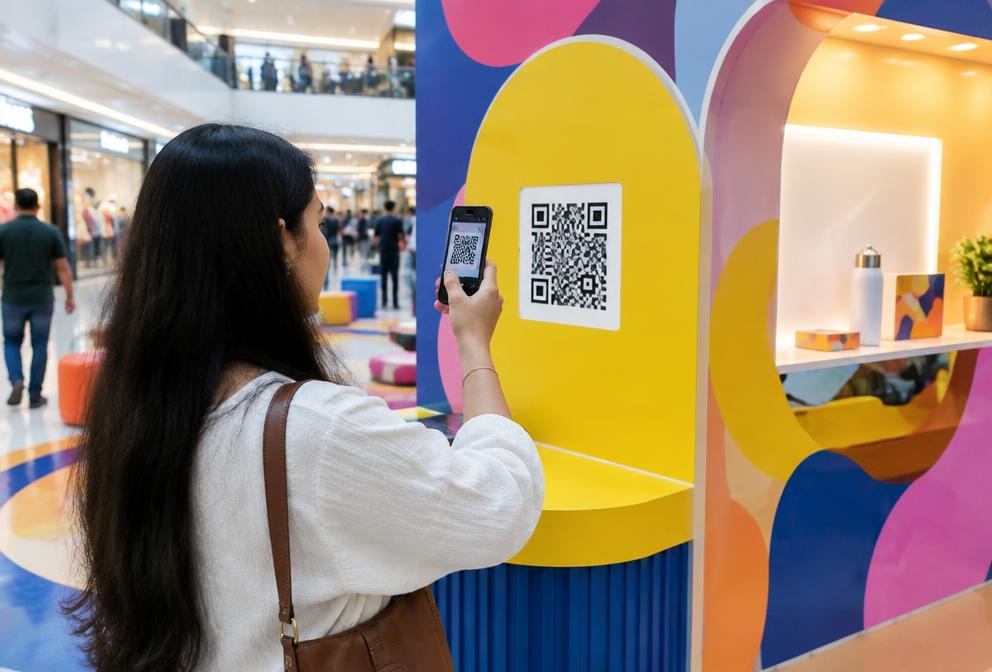
- Use QR codes at the venue to move a physical contact into a digital funnel without re-keying anything
- Track combined cost per sale across both channels, not channel-wise vanity metrics that cannot be compared
- Share the ground team's capture codes with whoever runs the digital retargeting, so the two halves of the plan can actually be measured as one funnel rather than two separate reports
Sequencing: which goes first
Order changes the result more than budget split does.
A ground activation launched with zero prior awareness is working harder than it needs to, convincing every single contact from a cold start; a few weeks of prior digital exposure means the promoter is confirming something the contact already half-recognises, which is a shorter and easier conversation to win.
Prime, then convert
Digital priming typically runs through the weeks leading into November to February, so the audience recognises the brand before a promoter starts the conversation — cold outreach converts worse than warm outreach in every format.
Trade-offs if you only run one
Neither channel is free of a structural weakness, and pretending otherwise is how a media plan ends up lopsided.
- Digital alone: strong reach, but no trial, no verified-on-the-spot lead and no local trust signal in categories where nominees, winners, their guests, leadership and sponsors gathered specifically for a recognition programme expect to see the product first
- Award Nights & Galas alone: strong trust and trial, but 5–10 working days to go live and a geographic ceiling that digital does not have
- Either channel run with no attribution: a budget that cannot be defended in the next planning cycle, regardless of which channel it was spent on
Reach tells you who saw it; award nights & galas tells you who touched it — and only one of those converts at the counter.
When this format isn't worth running at all
Award Nights & Galas is a poor fit when the product is purely digital, sold outside the cities where a team can physically operate, or when the buyer never needs to see, touch or ask about the product before paying — in those cases the trial advantage this format relies on simply does not apply, and the budget is better spent entirely on digital.
It is also a poor fit for a brand that cannot staff daily reporting — the format's main defence against wasted spend is the geo-tagged, auditable report, and without it there is no way to tell a working pilot from a quietly failing one.
A third case worth naming honestly: a brand testing a brand-new product in a category it has no track record in is often better served spending the first budget entirely on a cheap digital test of the message, and only then deciding whether the conversion gap is big enough to justify the longer lead time this format needs.
Planning award nights & galas?
Get an itemised plan and quote from BTL Marketing Co. within 24 hours.
Frequently asked questions
How much does award nights & galas cost in India?+
Indicative pricing is ₹10L – ₹1Cr per show. The final quote moves with the cities chosen, the number of days, team size, fabrication and the permissions each venue needs, so ask for an itemised breakup rather than one lump-sum figure.
How quickly can award nights & galas go live?+
A single-city pilot can go live in 5–10 working days. A regional rollout across several cities typically needs 14–21 working days once permissions and fabrication are built into the schedule.
Which Indian cities can run award nights & galas?+
Award Nights & Galas can be planned in any of India's 70 tracked cities, including Mumbai, Delhi, Gurgaon, Noida, Bangalore, Hyderabad, with tier 2 towns quoted on request.
How many award categories should a show run in one night?+
As many as the pacing plan can sustain, not as many as the nominee list allows. A show with too many categories run at the same format and the same length loses the audience well before the final award, which is why segment length and presentation style are varied deliberately.
Why does a trophy handover need its own planning?+
Because it is the moment every guest photographs, and an unplanned handover photographs badly even on a well-produced stage. Nominees are briefed in advance on where to stand and how the moment runs, so it reads cleanly rather than being improvised on the night.
Does the show need a dedicated host?+
In most cases, yes. A host paces the room between categories and absorbs the time pressure so presenters and winners do not have to, which is what keeps a long category list from feeling repetitive.
Can award nights & galas and digital ads run in the same month without clashing?+
Yes — they are rarely in competition for the same budget line if sequenced, since digital carries the awareness job in the weeks before the ground dates and the on-ground team carries conversion during and after them.
Which converts faster, award nights & galas or digital ads?+
Digital can show a click or a form fill within hours; this format cannot move that fast because permissions and training sit on the critical path before a single contact is made. What it can do, once live, is close a higher share of the people it actually talks to — the two are fast and slow in different parts of the funnel, not simply fast and slow overall.
If I can only afford one channel this quarter, which should it be?+
That depends on what the budget is meant to prove. If it needs to prove reach and generate quick learnings on messaging, digital first. If the product needs to be seen, touched or demonstrated before anyone will buy it, award nights & galas first — the trial advantage is the entire reason the format costs what it does, and skipping it defeats the point of choosing it at all.
Does award nights & galas replace a brand's digital budget?+
No, and treating it as a replacement rather than an addition is where this comparison is most often misread. The two solve different problems in the funnel, and cutting digital to fund this format usually just moves a weakness from one channel to the other instead of removing it.
Award Nights & Galas in top cities
More on award nights & galas
- Award Nights & Galas Cost in India: Price Guide & Budget Breakdown
- How to Plan a Award Nights & Galas Campaign: Step-by-Step Guide
- Award Nights & Galas Ideas That Drive Sales: Proven Formats
- How to Choose a Award Nights & Galas Agency in India: Vendor Checklist
- Award Nights & Galas for Consumer Brands: The Complete Playbook
- Measuring Award Nights & Galas ROI: Formula, Attribution & Worked Example